How International Wire Transfers and SWIFT Codes Work
Key takeaways
- A SWIFT or BIC code is an 8 or 11 character address that identifies a specific bank and branch anywhere in the world.
- The exchange-rate markup, not the flat fee, is usually the biggest hidden cost of an international wire.
- Money often hops through one or more correspondent banks, and each hop can skim a fee of $15 to $30.
- IBAN and SWIFT are used across Europe and much of the world, while the United States relies on routing numbers.
- Specialist transfer services often beat banks by giving the real mid-market rate and charging one clear fee.
- Once a wire is sent it is very hard to claw back, so triple-check every digit before you confirm.
You want to send money to someone in another country. Maybe it is tuition for a student studying abroad, a payment to an overseas freelancer, or help for family in another part of the world. Your bank hands you a form asking for a SWIFT code, an IBAN, an intermediary bank, and a pile of other details you have never heard of. It feels like being asked to speak a language you were never taught. This guide fixes that. By the end you will understand exactly how an international wire moves, where the real costs hide, and how to keep more of your money in the transfer.
Cross-border wires are different from the domestic transfers you may already know. A domestic wire or an ACH payment stays inside one country's banking system and one currency. An international wire has to cross borders, switch currencies, and often travel through banks that neither you nor your recipient chose. That extra distance is where the friction, the fees, and the confusion come from. Let us walk through it step by step.
What a SWIFT or BIC code actually is
SWIFT stands for the Society for Worldwide Interbank Financial Telecommunication. Despite the intimidating name, SWIFT does not move your money. It is a secure messaging network that banks use to send each other payment instructions. Think of it as the global postal system for money orders. The letter that travels is a message that says, in effect, please pay this account this amount. The actual cash settles separately between the banks.
A SWIFT code, also called a BIC or Bank Identifier Code, is the address on that letter. It is either 8 or 11 characters long, and it is not random. You can read it like this. The first four letters are the bank code, a shorthand for the institution. The next two letters are the country code, using the same two-letter system you see on passports, so US for the United States and GB for the United Kingdom. The next two characters are the location code, which points to the city or head office. If there are three more characters on the end, they identify a specific branch. An 8-character code with no branch section simply routes to the bank's main office.
Here is why the structure matters to you. When you copy a SWIFT code off an invoice, a single wrong letter can send your money to the wrong bank entirely, or bounce it back after days of limbo. Reading the code instead of blindly pasting it gives you a sanity check. If your recipient banks in Germany but the country code in the SWIFT reads FR, something is wrong. That two-second glance can save you a two-week headache.
The correspondent bank chain, or why your money takes detours
Here is the part almost nobody explains. Your bank and your recipient's bank usually do not have a direct relationship. A community bank in Ohio does not hold an account with a small bank in Vietnam. So how does the money get there? Through correspondent banks. These are large global banks that maintain accounts with each other and act as the connecting hubs of the financial world.
Picture a traveler flying from a small regional airport to another small regional airport on the far side of the planet. There is no direct flight. You connect through one or two big hub airports along the way. International money works the same way. Your money may pass from your bank, to a large correspondent bank, sometimes to a second correspondent bank, and finally to your recipient's bank. Each of those hubs is a real bank doing real work, and each one can charge for it.
This chain is the single biggest reason international wires cost more and take longer than you expect. It is also why the amount that lands can be less than the amount you sent. Every correspondent bank in the path may deduct its own fee from the money as it passes through. Nobody announces this at the counter. The money just quietly shrinks along the way.
There is one useful piece of jargon here. When your bank charges a fee to send, that is straightforward. When intermediary banks deduct fees from the transfer amount itself, those are often called lifting fees or intermediary charges. Some services let you choose who pays these. The options usually appear as OUR, where you the sender cover all charges so the recipient gets the full amount, SHA, where charges are shared, and BEN, where the recipient absorbs everything. If it matters that your recipient receives an exact figure, ask for the OUR option and expect to pay a bit more up front.
It also helps to know that you often cannot pick the correspondent path yourself. Your bank has standing relationships and it routes through them automatically. This is why two people sending the same amount to the same country can end up paying different intermediary fees. One bank might have a direct relationship that skips a hop, while another leans on two correspondents. You can ask your bank which route it uses and how many intermediary charges to expect, and a good teller will tell you. If they cannot, that alone is a reason to compare a specialist service that quotes the whole cost up front.
IBAN versus routing number, and who uses what
Different parts of the world label accounts differently, and mixing them up is a classic cause of failed transfers. An IBAN, or International Bank Account Number, is used across Europe, the Middle East, and much of the rest of the world. It is a long string, up to 34 characters, that starts with a two-letter country code and packs the bank, branch, and account number into one standardized format. Its whole purpose is to make cross-border payments less error-prone, because the format itself can be checked for mistakes before the money moves.
The United States does not use IBANs. Instead, American banks use a nine-digit routing number, sometimes called an ABA number, to identify the bank, plus a separate account number. So when someone in Europe asks a person in the US for their IBAN, the honest answer is that there is not one. What the sender needs instead is the US bank's SWIFT code, the routing number, and the account number.
Keep the roles clear in your head. The SWIFT or BIC code points to the bank. The IBAN or the account number points to the specific account inside that bank. Most international wires need both a bank identifier and an account identifier. Give the sender the wrong combination and the wire either bounces or sits in a queue while a human tries to figure out where it was meant to go.
How long an international wire really takes
The honest answer is that it depends, but there is a normal range. Most cross-border wires arrive within one to three business days. Simple transfers between major currencies and large banks can land the same day or the next. Transfers that route through several correspondent banks, or that involve smaller banks in less common currencies, can stretch to four or five business days.
Several things slow a wire down. Weekends and public holidays do not count as business days, and holidays differ by country, so a wire sent Friday afternoon before a holiday in the receiving country can sit until the middle of the next week. Time zone gaps mean a payment sent late in your day may not be processed until the next morning on the other side. And compliance checks, which banks run to screen for fraud and sanctions, can add a day if anything in the transfer needs a closer look. None of this means something is wrong. It is simply the machinery working.
There is also a cutoff time to respect. Every bank has a daily deadline for same-day wire processing, often in the early afternoon. Miss it and your transfer is treated as if it started the next business day, even though your money left your account. If timing genuinely matters, ask your bank for its wire cutoff time and send well before it. And if a wire seems truly stuck, both the sending and receiving banks can trace it using the SWIFT reference number attached to the transfer. Keep that number. It is the tracking code for your money, and it is the fastest way to find out where a delayed payment is sitting.
The fees you can see, and the one you usually cannot
International wire costs come in a few layers, and understanding each one is how you stop overpaying. The first layer is the outgoing wire fee your own bank charges. For many US banks this runs in the range of $35 to $50 for an international wire, though some online banks and credit unions charge less. The second layer is the receiving fee. Some banks charge the recipient a fee, often $10 to $20, just to accept an incoming wire. The third layer is the intermediary or correspondent fees we covered above, typically $15 to $30 per hop, skimmed from the amount in transit.
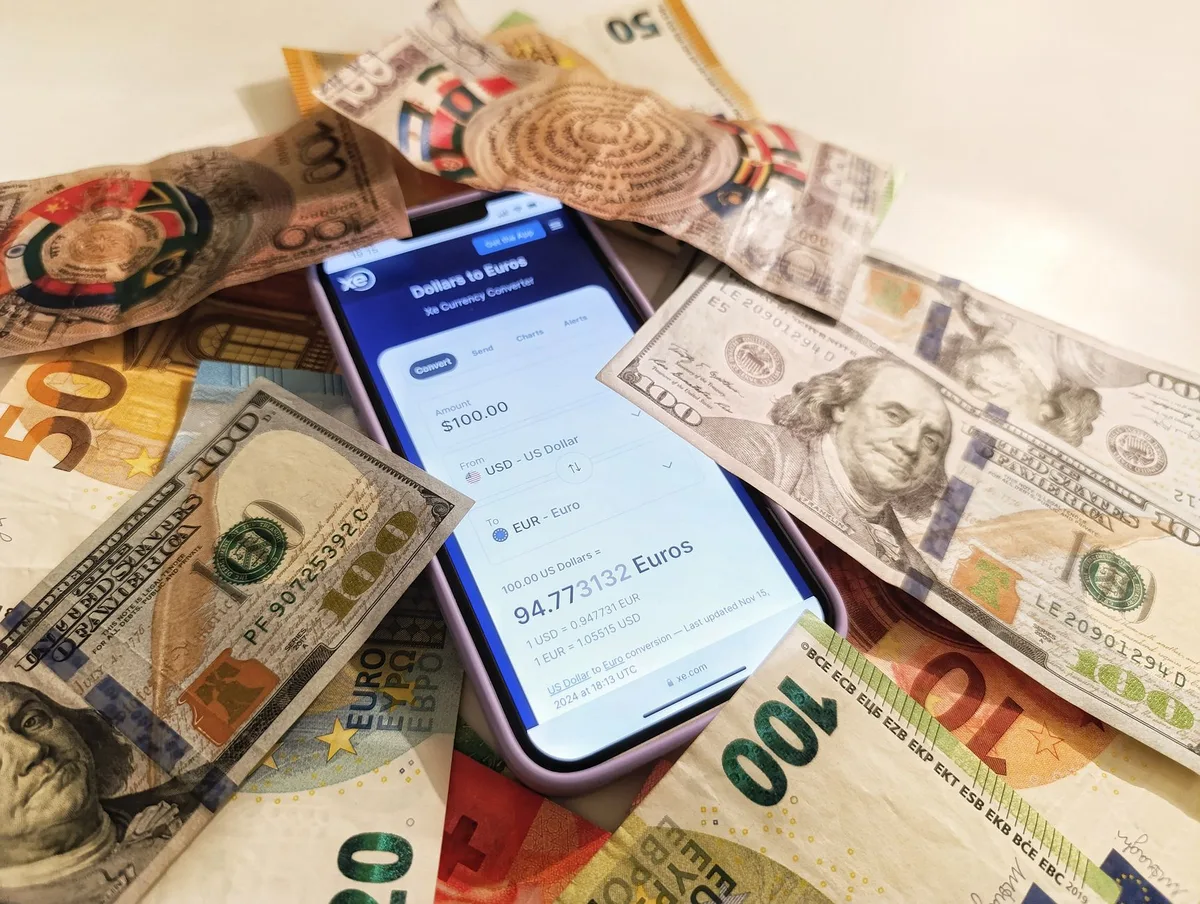
Now for the layer that costs the most and shows up the least: the exchange-rate markup. When your dollars are converted into another currency, there is a real market rate, often called the mid-market rate, that you can look up in seconds. Banks rarely give you that rate. Instead they build in a margin, commonly one to three percent, and keep the difference. It never appears as a line item labeled fee. It hides inside the exchange rate itself.
The reason this matters so much is scale. A flat $45 wire fee is $45 whether you send $500 or $5,000. But a two percent exchange markup on a $5,000 transfer is $100, quietly larger than the visible fee. On big transfers the rate markup often dwarfs everything else combined. The slider below lets you see how these pieces stack up on a transfer of your own size.
How to avoid overpaying on a cross-border transfer
Once you know where the money leaks, plugging the holes is straightforward. The single biggest lever is comparing the exchange rate, not just the advertised fee. Ask what rate you are being given, then compare it to the mid-market rate for that currency pair. The gap is your true cost of conversion. A service that charges a slightly higher flat fee but gives you a rate close to mid-market can easily beat a bank that waves a low fee while pocketing three percent on the exchange.
This is where specialist money-transfer services often win against traditional banks for personal transfers. Many of them advertise the real mid-market rate and charge one transparent fee on top, so you can see exactly what you are paying. For a larger transfer, the difference between a bank and a specialist can be a meaningful chunk of money. That said, banks still make sense for some situations, especially very large transfers where wire security and a paper trail matter, or when your recipient specifically needs a bank-to-bank wire.
A few more practical moves keep costs down. Send in one larger transfer rather than several small ones when you can, since flat fees repeat on every transfer. Ask whether your bank offers the OUR fee option so intermediary deductions do not eat into what your recipient receives. Check whether sending in the recipient's local currency, rather than sending dollars for them to convert, gives a better overall result. Often letting the transfer service handle the conversion up front beats leaving it to a chain of foreign banks. And if you send money abroad regularly, it is worth opening an account with a service built for it rather than paying bank wire fees every single time.
Staying safe and avoiding wire fraud
The banking rails are heavily regulated and secure. The real risk with wires is not the technology. It is fraud. Because international wires are fast and extremely hard to reverse once completed, scammers love them. This is exactly why a criminal will pressure you to wire money quickly and quietly. Speed and secrecy are the whole scam.
A few habits protect you. Never act on payment instructions that arrive by email alone, especially if they change previously agreed account details. Business email compromise, where a fraudster spoofs a vendor or a boss and asks you to wire funds to a new account, drains real money from real people every day. Always confirm any new or changed wire details by calling a phone number you already know, not one provided in the suspicious message. Be deeply skeptical of urgency. Legitimate payees rarely need money wired within the hour or your world will end.
Watch for the classic setups too. Nobody legitimate asks to be paid by wire for a job you were surprised to be offered, a prize you did not enter to win, or a romance that has never met you in person and suddenly has an emergency abroad. If you must send a wire to someone you have not dealt with before, verify who they are through an independent channel first. And remember your rights. Under federal remittance rules you are generally entitled to a disclosure of the exchange rate, fees, and the amount your recipient will receive before you pay, plus a short window to cancel. Read that disclosure. It exists to protect you.
What information you need to send an international wire
When you are ready to send, having every detail correct the first time saves days. Gather the recipient's full legal name exactly as it appears on their account, and their full physical address, since many banks require it. Get the receiving bank's name and address. Get the SWIFT or BIC code for that bank. Get the account number, or the IBAN if the recipient is in a country that uses one. For some destinations you may also need a national clearing code, such as a sort code in the United Kingdom or a routing number equivalent elsewhere.
Before you confirm, slow down and read every character back. Wire details are unforgiving. A transposed digit in an account number or a wrong letter in a SWIFT code can send your money into limbo, and getting it back can take weeks if it comes back at all. Confirm the amount, the currency, who is covering the fees, and the exchange rate you are being offered. Once you approve, you generally have only a short cancellation window before the transfer is out of your hands.
Sending money across borders will never feel as effortless as tapping a card. But it stops feeling like a mystery once you can read a SWIFT code, picture the correspondent chain, and spot the exchange-rate markup for what it is. Know those three things and you are already ahead of most people standing at the counter. Compare your rate, verify your recipient, double-check every digit, and the money will get where it needs to go without taking more of your money than it should.
Banks profit from what their customers do not know.
Every fee, teaser rate, and disclosure is a test you are taking whether you study or not. The Financial IQ Test scores your real money knowledge across 90 tests and shows you the gaps before a bank finds them first.
Test your Financial IQQuestions people ask
How long does an international wire transfer take?
Most cross-border wires arrive in one to three business days. If the money passes through several correspondent banks, or crosses time zones and weekends, it can take up to five business days. Wires sent to major currencies and large banks tend to move fastest.
What is the difference between a SWIFT code and an IBAN?
A SWIFT or BIC code identifies the bank itself. An IBAN identifies the specific account at that bank. Many countries ask for both. You need the SWIFT code to route the money to the right institution, and the IBAN to land it in the right account.
Can I cancel or reverse an international wire after sending it?
Reversing a completed wire is difficult and not guaranteed. Under Remittance Transfer rules you generally have 30 minutes to cancel before the funds are picked up or deposited. After that, getting money back depends on the receiving bank cooperating, which can take weeks.
Why did the recipient get less money than I sent?
Two things usually cause this. The exchange rate your bank used may have included a markup of one to three percent. And one or more intermediary banks may have each deducted a fee of $15 to $30 as the money passed through. Ask your bank to disclose both before you send.
Are international wire transfers safe?
The banking rails themselves are secure and regulated. The real danger is fraud, where a scammer tricks you into wiring money to them. Because wires are fast and hard to reverse, always verify payment details through a trusted channel before sending, especially if the request feels urgent.
Do I need the recipient's full address to send a wire?
Often yes. Many banks require the recipient's full name and physical address, the receiving bank's name and address, the SWIFT or BIC code, and the account number or IBAN. Missing details are the most common reason a wire is delayed or returned.
Keep reading
Never Pay a Bank Fee Again: The Complete Playbook

CD Ladders Explained: Lock In Rates Without Locking Up Your Life

The Emergency Fund Guide: How Much, Where, and How Fast
The Flourish Letter
One smart money idea each week, charts included. Join free and get the printable 2026 Money Calendar in your welcome email.