How to Choose a Bank: A Seven-Factor Checklist for 2026
Key takeaways
- Judge any bank on seven things: fees and minimums, the interest it pays, its ATM network and reimbursements, branch versus online access, deposit insurance, app quality, and customer service.
- The single biggest money leak is not fees but idle cash, because parking $15,000 in a big-bank savings account paying near zero instead of a high-yield account near 4 percent costs about $600 a year.
- There are four basic kinds of banks: big national banks, community banks, credit unions, and online banks. Most people are best served by pairing one online bank for savings with a convenient local account for cash and deposits.
- Insurance is not a comparison factor, it is a pass-fail gate: only bank at an FDIC-insured bank or an NCUA-insured credit union, and confirm it yourself in about two minutes.
- The right bank depends on how you actually live, so match the choice to whether you deal in cash, travel, want branches, or just want the highest safe yield.
- Overdraft traps, monthly fees you can never quite waive, and teaser rates that quietly drop are the red flags that should send you looking elsewhere.
Almost nobody chooses a bank on purpose. Most people bank where their parents banked, where the branch was near their first apartment, or where a booth on campus handed out a free water bottle. Then they stay for a decade because switching feels like a chore. That inertia is expensive. The bank you drifted into is quietly deciding how much your savings earns, how many fees leak out of your checking account, and how much of a headache it is to get help when something goes wrong. The good news is that choosing well is not complicated once you know what to look at. This guide gives you a seven-factor checklist, walks through the four kinds of banks and who each one fits, and ends with a step-by-step way to pick and switch without missing a payment.
Why this choice is worth an afternoon
A bank is a tool, and like any tool it is only as good as the job you need it to do. The trouble is that banks are very good at looking similar. They all have apps. They all promise convenience. They all say your money is safe. Underneath that sameness, the real differences are large and they compound quietly.
Here is the number that should get your attention. Suppose you keep $15,000 in savings, which is a reasonable emergency fund for many households. At a typical big national bank paying close to nothing on savings, that money earns just a few dollars a year. At an online bank or credit union paying around 4 percent, the same $15,000 earns roughly $600 a year. Same money, same safety, same federal insurance. The only difference is which bank holds it. Over five years that gap is about $3,000, and that is before you count the monthly fees and overdraft charges that big banks collect and online banks usually do not.
That is the whole case for spending an afternoon on this. You are not chasing a jackpot. You are plugging a slow leak that runs for years. Now here is how to compare banks the way that actually matters.
The seven factors that actually matter
Ignore the sign-up bonuses and the friendly commercials for a moment. When you strip a bank down to the parts that affect your wallet, seven things are left. Score any bank on these and the winner usually becomes obvious.
1. Fees and minimum balances
Fees are where banks quietly take back the interest they pay you, and then some. Watch for four kinds. There is the monthly maintenance fee, often $5 to $25, sometimes waived if you keep a minimum balance or set up a direct deposit. There is the overdraft fee, historically around $35 per item, which is the most painful fee most people ever pay. There are out-of-network ATM fees, which can be charged by both your bank and the machine. And there are the small stuff fees for paper statements, wire transfers, or falling below a minimum.
The 2026 standard you should aim for is simple. No monthly maintenance fee, or one you can waive easily and permanently. No minimum balance requirement, or one you comfortably clear. And a bank that has either eliminated overdraft fees or offers a genuine no-fee overdraft cushion. Plenty of online banks and credit unions meet all three. If a bank cannot, it needs to be winning big somewhere else to justify staying.
2. The interest it pays you
This is the factor most people underrate and it is often the most valuable one. The interest rate on a savings account is expressed as an APY, the annual percentage yield, which already accounts for compounding. In 2026 the spread between banks is enormous. Many of the largest national banks pay a small fraction of a percent on savings, which is essentially nothing. Online banks and many credit unions pay several percent. On checking, most banks pay little or nothing, so the action is in where you keep savings.
Do not overthink chasing the single highest rate on any given day. Rates move, and the difference between the top account and a solidly competitive one is usually small. What matters is not sitting in an account paying near zero. The slider below lets you see for yourself what an APY difference does to a real balance over time. Move it around with your own numbers before you read on.
3. The ATM network and reimbursements
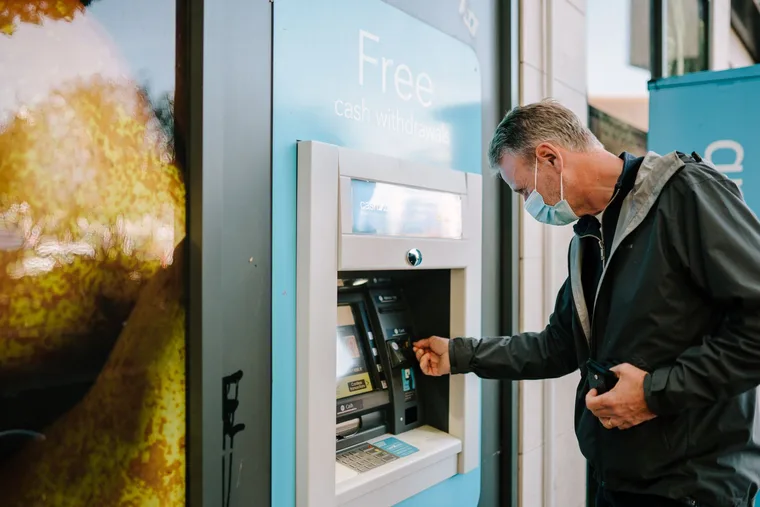
Cash still matters, and getting to your cash without paying for the privilege is a real feature. Look at two things. First, how large is the bank's own or partnered surcharge-free ATM network. Big national banks have tens of thousands of machines. Many credit unions join shared networks that give members access to far more ATMs than the credit union owns. Online banks, which have no branches, often reimburse a set amount of out-of-network ATM fees each month, sometimes without limit.
If you withdraw cash regularly, an out-of-network ATM fee of a few dollars twice a week adds up to hundreds of dollars a year. A bank with a big free network or generous reimbursements erases that cost entirely. If you almost never touch cash, this factor matters less, and you can weight it lightly.
4. Branch access versus online-only
This is the fork in the road that decides a lot. A bank with real branches lets you deposit cash, get a cashier's check, sit across from a person for a big loan, and get notary services. An online-only bank gives up all of that in exchange for higher interest and lower fees, because it does not pay for buildings and tellers.
Be honest about how you actually live rather than how you imagine you might. Many people have not walked into a branch in years and would happily trade the option for an extra few hundred dollars of interest. Others deal in cash, run a small business, or simply feel better knowing a desk exists nearby. Neither answer is wrong. What is wrong is paying for a branch network you never use, or choosing online-only and then struggling every time you need to deposit a stack of cash.
5. Deposit insurance
This one is not a comparison factor at all. It is a pass-fail gate you check before anything else matters. A bank should be insured by the FDIC. A credit union should be insured by the NCUA. Both cover at least $250,000 per depositor, per institution, per ownership category. That protection is what makes a bank account boring and safe, and it has held through every bank failure for generations.
The rule is simple. If an institution is not FDIC or NCUA insured, do not put your money there, no matter how high the advertised rate. This matters most with newer fintech apps, some of which are not banks themselves but pass your money to partner banks. In those cases the insurance depends on the partner and on how the money is held, so read carefully and confirm. You can verify any bank in about two minutes using the FDIC BankFind tool, and any credit union on the NCUA site.
6. The app and digital tools
You will interact with your bank through its app far more than through any branch, so the app is not a nice-to-have. It is where you live. A good banking app lets you deposit checks with your phone camera, move money between accounts and to other people quickly, freeze a lost card instantly, set balance and transaction alerts, and see your spending clearly. The best add budgeting views and automatic savings tools.
Big banks generally have polished, feature-rich apps because they can afford large technology teams. Online banks live or die by their apps and usually invest heavily in them. Credit unions are the most variable. Some have excellent apps and some feel a decade behind. Before you commit, read recent app store reviews, and weight the complaints about crashes, failed transfers, and slow deposits far more heavily than complaints about colors.
7. Customer service
You will rarely need a human, but when you do it is usually urgent. A fraudulent charge, a frozen account while traveling, a transfer that vanished, a dispute that needs a person. Look at how you can reach support and how fast. Is there 24-hour phone service. Is there real chat with a person, not just a bot. Do branches exist if you want to walk in. Read reviews specifically about problem resolution, not about the friendly teller.
Credit unions often win here on attitude, since members are owners rather than customers to be upsold. Big banks win on hours and channels. Online banks vary, so this is worth checking closely before you move your primary account to one.
The four kinds of banks
Almost every option you will meet falls into one of four buckets. Each has a personality, and the honest summary is that the best answer for many people is not one bank but a pairing. The table below is sortable so you can rank by what you care about most.
A few things the table cannot hold. Big national banks are the default for a reason. They are everywhere, their apps are strong, and they can handle every product under one roof. You pay for that reach with low interest and more fees. Community banks are smaller local banks that often bring back the personal service big banks lost, with decent rates and real relationships, though their technology can lag. Credit unions are member-owned nonprofits, which is why they so often pay more and charge less, and shared branching networks make many of them far more convenient than their size suggests. Online banks trade away branches entirely for the best combination of high interest and low fees, which makes them the natural home for savings even if you keep checking elsewhere.
Match the bank to the life you actually live
The right choice depends on which of these people sounds most like you.
The cash-and-convenience person. You deposit cash, you like a branch nearby, and you want everything in one place. A big national bank or a solid community bank fits. Accept that you will earn little on savings, and fix that by opening a separate high-yield savings account at an online bank for your emergency fund. You get the branch and the interest, just in two places.
The digital native. You have not walked into a branch in years, you deposit checks with your phone, and you would happily trade the branch for better numbers. Go online-only or lead with a credit union that has a strong app. You will pay fewer fees and earn far more, and you will barely notice the missing lobby.
The relationship seeker. You want people who know your name, fair loan rates, and a sense that the institution is on your side. A credit union or a community bank is built for you. Check the membership requirement for a credit union, which is usually easy to meet, and confirm the app is good enough for your daily needs.
The rate maximizer. You want your money working as hard as safely possible and you are comfortable managing accounts online. Keep a small checking account wherever is convenient, and hold your savings at whichever insured online bank or credit union pays a strong, stable rate. Do not chase every temporary top rate. Pick a consistently competitive one and let it run.
Notice the pattern. For most people the smartest setup is not a single perfect bank but a deliberate pair. One account where money comes and goes conveniently, and one where money sits and grows at a real rate. The visual below shows the difference that pairing makes over five years compared with keeping everything at a single low-rate bank.
Red flags and fine print
Some patterns reliably mark a bank you should approach carefully or avoid. None of these is illegal, but each one is a signal about how the bank makes its money from you.
- Overdraft programs that reorder transactions. Some banks have historically processed the largest charges first to trigger more overdraft fees on the smaller ones. Favor banks that have eliminated overdraft fees or offer a real no-fee grace cushion. The CFPB has pushed hard on this, and the better banks now compete on it.
- A monthly fee you can never quite escape. If the fee waiver requires a balance you rarely hit or a direct deposit you cannot set up, the fee is not really waivable. Treat it as a permanent cost and compare accordingly.
- Teaser rates that quietly drop. A savings rate that is spectacular for three months and then falls to average is a marketing tool, not a real yield. Look at the ongoing rate, not the promotional one, and expect all rates to move with the wider environment.
- Bonuses with heavy strings. A cash bonus for opening an account can be genuinely worth it, but read the requirements. A large minimum balance held for months, or a fee that eats the bonus, can make it a bad trade.
- No clear deposit insurance. Any app or account that is vague about whether and how your money is federally insured is a hard stop. Boring, confirmed insurance is a feature, not a formality.
- Pressure and cross-selling. A bank that turns every interaction into a pitch for a credit card, a loan, or an investment product is optimizing for its revenue, not your outcome. You are allowed to just want a checking account.
How to actually choose, step by step
Enough theory. Here is a process you can run this week that turns the seven factors into a decision.
A couple of details deserve emphasis. First, do not try to find one bank that wins every factor, because it usually does not exist. Decide which two or three factors matter most for your life, and let those break the tie. For most people the deciding factors are fees, interest, and how they handle cash. Second, remember that you are allowed to use more than one bank, and that is often the winning move rather than a compromise.
Switching without missing a payment
If this article just diagnosed your current bank as expensive or low-yielding, the fix is straightforward, but the order matters. The mistake people make is closing the old account too soon, before every automatic payment has moved, which leads to bounced bills and fees.
Do it in this order. Open and fund the new account first. Make a list of every direct deposit coming in and every automatic payment going out, which your last two or three months of statements will show. Move the direct deposits by giving your employer the new account details. Move the autopays one at a time, updating each biller. Then wait. Keep the old account open with a comfortable cushion for two full billing cycles so nothing bounces while stragglers catch up. Only after you confirm that every deposit has landed and every autopay has switched should you drain the old account and formally close it. Get the closure in writing so a forgotten fee does not quietly reopen a balance.
The whole switch takes a few weeks of low effort, most of it just waiting. Set the money in motion, then let time do the work while you go about your life.
The bottom line
Choosing a bank is not about finding the one perfect institution. It is about matching how you actually live to a bank, or a pair of banks, that pays you a fair rate, charges you as little as possible, keeps your money federally insured, and does not make you fight for help when you need it. Score your options on the seven factors, weight the two or three that matter most to you, and confirm the insurance before anything else. For a lot of people the answer is a convenient local account for cash and daily spending plus a high-yield online account for savings. Spend one afternoon getting this right, and it quietly pays you back every year for as long as the accounts stay open.
Banks profit from what their customers do not know.
Every fee, teaser rate, and disclosure is a test you are taking whether you study or not. The Financial IQ Test scores your real money knowledge across 90 tests and shows you the gaps before a bank finds them first.
Test your Financial IQQuestions people ask
Is it better to bank with a big national bank or an online bank?
It depends on what you value. Big national banks win on branches, ATMs, and one-stop convenience, but they usually pay almost nothing on savings and charge more fees. Online banks pay far higher interest and charge fewer fees, but you cannot walk into a branch or deposit cash easily. Many people get the best of both by keeping everyday checking at a convenient bank and their savings at an online bank.
How do I know if my bank is safe?
Confirm it carries federal deposit insurance before you deposit a dollar. Banks are insured by the FDIC and credit unions by the NCUA, both up to at least $250,000 per depositor, per institution, per ownership category. You can verify any bank at the FDIC BankFind tool or any credit union at the NCUA site. If an institution is not on those lists, do not put your money there.
Should I use a credit union instead of a bank?
For a lot of people, yes. Credit unions are member-owned nonprofits, so they often pay higher interest on savings, charge lower fees, and offer better loan rates. The tradeoffs are smaller branch networks and sometimes older apps, though many belong to shared branching and surcharge-free ATM networks that expand their reach. You usually have to meet a simple membership requirement, which is often just living in an area or making a small donation.
How many bank accounts should I have?
Most people do well with two or three. A common setup is one checking account at a convenient bank for bills and daily spending, one high-yield savings account at an online bank for your emergency fund and goals, and sometimes a second checking account kept separate for a specific purpose. There is no penalty for holding accounts at several institutions, and the deposit insurance limit applies per bank, so spreading large balances can even add protection.
Do I have to keep a minimum balance to avoid fees?
At many big banks, yes, unless you meet a waiver such as a recurring direct deposit or a linked account. Read the fee schedule before you open anything and check exactly how the monthly fee gets waived. Plenty of online banks and credit unions charge no monthly maintenance fee and require no minimum balance at all, which removes the problem entirely.
What is the easiest way to switch banks without missing a payment?
Open the new account first and fund it, then move your direct deposits and automatic payments one at a time. Keep the old account open with a small cushion for two full billing cycles so nothing bounces while transfers catch up. Only after you confirm every deposit and autopay has landed at the new bank should you drain and close the old account.
Keep reading
Never Pay a Bank Fee Again: The Complete Playbook

CD Ladders Explained: Lock In Rates Without Locking Up Your Life

The Emergency Fund Guide: How Much, Where, and How Fast
The Flourish Letter
One smart money idea each week, charts included. Join free and get the printable 2026 Money Calendar in your welcome email.