How to Spot and Report Bank Phishing Scams in 2026
Key takeaways
- Bank phishing, smishing, and vishing all try to steal logins, one-time codes, or payments you send yourself under fake urgency.
- Real banks will not ask you to read back a one-time code, buy gift cards, or Zelle money to a "safe account" to reverse fraud.
- If you clicked or shared credentials, call the number on your card immediately, lock the account, change passwords, and put the report in writing the same day.
- Report to your bank first for money recovery, then to the FTC at ReportFraud.ftc.gov, and to IC3 at ic3.gov for internet-enabled fraud when losses are material.
- Card locks, bank holds, and credit freezes do different jobs; use all three when personal data may have been exposed.
- Unauthorized electronic transfers reported quickly have far stronger consumer protections than payments you authorized because a scammer tricked you.
The text lands at 9:14 p.m. Your bank. A blocked purchase. A link that says "Secure your account now." Your pulse jumps, your thumb hovers, and for one long second the smartest move feels like tapping the link before the crooks finish the job. That second is the entire product design of bank phishing. The criminals are not trying to outsmart a security expert. They are trying to stampede a tired person who already trusts the name on the card.
Phishing (email and fake sites), smishing (text), and vishing (voice calls) are the three main doors scammers use to steal bank logins, one-time codes, and the money those credentials unlock. This guide is for US readers who want a clear playbook: how the scams work, how real banks actually contact you, what to do if you already clicked, how to report, how to freeze damage, and how to watch your credit while you recover. It is education, not legal advice, and every step below is something an ordinary household can do tonight.
How bank phishing, smishing, and vishing work
All three methods share one goal. The attacker needs something only you can supply: a password, a one-time code, a remote-access approval, a card number, or a payment you send yourself. They manufacture urgency so you skip the pause that would save you.
Phishing usually arrives as email that looks like your bank, credit union, card network, or a payment app. The message claims suspicious activity, a failed deposit, a closed account, or an unclaimed refund. The link opens a page that copies the real login screen closely enough to fool a glance. When you type credentials and the code that just texted your phone, the scammer captures both and logs into the real site before the code expires.
Smishing is the same trick over text. Short, urgent messages with shortened links are common because they look like bank alerts you already receive. Some texts invent a "Zelle" or "Venmo" request you never made. Others claim a package, IRS notice, or utility shutoff and then pivot into a bank-style login. Because texts feel more personal than email, people click them faster.
Vishing is the voice version. A caller claims to be fraud prevention. They already know the last four digits of your card or a recent merchant name, which they often learned from a data leak, a stolen statement, or a previous phish. They walk you through "verifying" by reading back a code, installing remote support software, or sending money to a "safe account" to reverse a fake theft. Real banks do not ask you to read one-time codes back to them, and they do not ask you to Zelle yourself to undo fraud.
Once the attacker has a foothold, the next moves are predictable. They change your email or phone on file so alerts go to them. They open new payees, enable instant transfers, or drain savings into accounts they control. They may also use your identity to open credit elsewhere, which is why credit monitoring after a bank phish is not optional theater. It is damage control.
Red flags that almost always mean scam
Train yourself to treat these patterns as automatic stops. One red flag is enough to hang up, close the tab, and start over through a channel you chose.
- Urgent loss language. "Your account will be closed in 30 minutes," "unauthorized wire in progress," "act now or lose protection." Legitimate problems can be urgent, but real banks do not force you through a random link under a countdown.
- Links that do not match the brand domain. Hover on a computer or long-press on a phone. If the real destination is a lookalike spelling, a random subdomain, or a shortened URL, do not open it.
- Requests for secrets. Full Social Security number, full card number with CVV, online banking password, seed phrases, or one-time codes typed into a page you reached from a message.
- Requests to move money "to safety." Any story that ends with you sending funds, buying gift cards, loading crypto, or transferring to a new account the caller controls is a scam.
- Pressure to stay on the line. "Do not hang up or the transfer completes." That is theater. Hang up and call the number on your card.
- Poor spelling, wrong logos, or odd from-addresses. Not every scam is sloppy, but many still are. A polished message can still be fake; a messy one almost never is real.
- Unexpected remote-access tools. Asking you to install AnyDesk, TeamViewer, or similar so "support can secure the account" is a classic vishing play. Hang up.
None of these alone prove crime in a court sense. They do prove you should stop, verify offline, and refuse to hand over control while adrenaline is high.
What real banks actually do (and do not do)
Knowing normal bank behavior is the fastest filter. Practices vary by institution, but several norms hold across large US banks and credit unions in 2026.
Real banks may text or email about a suspicious charge and invite you to reply YES or NO, or to open their official app. They may call from a number that does not match the number on your card. That last point confuses people, because spoofed caller ID is also common. The safe rule is not "trust the number on the screen." The safe rule is "end the conversation and call back using the number on the back of the card or the number inside the app you already installed."
Real banks do not ask you to confirm a one-time passcode by reading it aloud to a caller. The code is meant for you to type into a site or app you opened yourself. If someone on the phone asks for the code that just arrived, they are the attacker intercepting a login.
Real banks do not ask you to buy gift cards, crypto, or money orders to protect an account. They do not ask you to wire funds to a "treasury" or "federal" holding account. They do not require remote desktop software for routine fraud review. They do not threaten arrest over a banking issue in a cold call. When a story requires you to send value outward to stay safe, the story is the crime.
Real banks also give you time to verify. A fraud desk that is legitimate will still be there after you hang up and call the published number. A scammer needs the session alive while fear is peak.
If you already clicked, typed, or talked
Shame is useless and delay is expensive. Assume compromise the moment credentials, a code, a card number, or remote access may have been shared. Work the steps in order.
1. Stop the session. Close the browser tab. Do not keep chatting with the caller. If remote software is open, disconnect the internet if you must, uninstall the tool, and restart the device later after the urgent banking steps.
2. Call the bank from a trusted number. Use the number on your debit card, credit card, or official app, not the number in the message. Say clearly that you may have given credentials or codes to a phishing attempt. Ask them to lock or freeze the affected card and online access, review recent sessions, and reverse unauthorized electronic transfers.
3. Change passwords from a clean device if you can. Prioritize the bank login, then email (email is the recovery key for everything else), then any reused password. Turn on two-factor authentication, preferably with an authenticator app rather than SMS when the bank offers it.
4. Put the report in writing the same day. Use the bank's secure message, fraud form, or email path they give you. Note the date and time you first noticed the problem, the transactions, and the representative name or case number. Under federal electronic transfer rules (Regulation E), how fast you report can change how much liability you keep on unauthorized transfers.
5. Watch for secondary damage. Scammers often return days later posing as the same bank "finishing the case." They already know what happened. Hang up and call the published number again.
If money left the account without your permission, ask specifically about unauthorized electronic fund transfers and provisional credit. If you sent money yourself because the scammer convinced you to, say so honestly. That path is harder to reverse, but speed still matters for wires and some person-to-person rails, and the bank may still investigate.
Reporting map: bank, FTC, IC3, and local police
Reporting will not always recover dollars the same day. It does create a dated record, feeds investigations, and strengthens disputes. Use more than one channel when the loss is real.
- Your bank or credit union fraud desk first. This is the money path. Freeze cards, reverse unauthorized transfers where rules allow, and open a case number you keep forever.
- FTC at ReportFraud.ftc.gov. File a fraud report with the Federal Trade Commission. It is free, takes minutes, and feeds the Consumer Sentinel Network used by law enforcement and researchers. If identity theft is involved, also use IdentityTheft.gov for a recovery plan and an identity theft report.
- FBI Internet Crime Complaint Center (IC3) at ic3.gov. Use IC3 for internet-enabled crime, especially larger losses, business email compromise style schemes, and cyber-enabled fraud that crossed state lines. Include dates, amounts, usernames, wallet addresses if crypto was involved, and any phone numbers or domains.
- Local police report. Especially useful when a significant sum is gone, when you need documentation for a bank or insurer, or when the scammer may be local. Bring your bank case number and FTC confirmation.
- Your mobile carrier. If SMS codes were intercepted or a SIM swap is possible, add a port-out PIN and report the incident. Carrier locks stop a second wave of takeovers.
- Credit bureaus and free annual reports. Place free credit freezes at Equifax, Experian, and TransUnion if personal data may have been exposed. Pull reports at AnnualCreditReport.com and dispute accounts you did not open.
Keep a single folder, digital or paper, with screenshots of the original message, the fake URL if you still have it, bank letters, case numbers, and report confirmations. Recovery is a paperwork sport as much as a phone-call sport.
Account freeze, card lock, and damage control
People mix up three different freezes. Each solves a different problem.
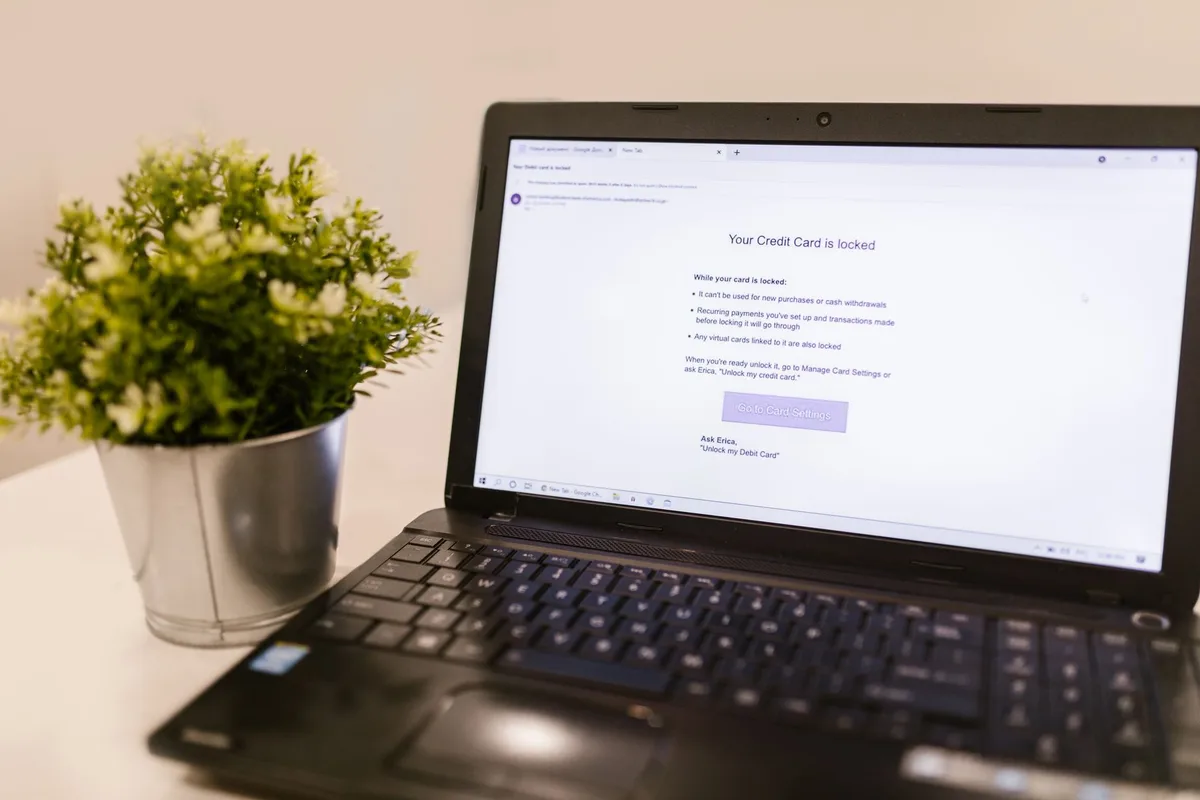
Card lock or temporary debit freeze stops new charges on a specific card. Most bank apps can do this in seconds. Use it the moment you suspect a phish, even before you finish the full password reset.
Account freeze or hold by the bank is a broader block the fraud team can place so funds cannot leave while they investigate. Ask for it if large unauthorized activity is underway. Confirm how bills and direct deposit will be handled while the hold is on so you do not bounce rent by accident.
Credit freeze at the three bureaus does not stop charges on existing bank accounts. It stops most new credit from being opened in your name. After a bank phishing hit, freezes are still smart because stolen credentials often travel with identity data that enables new-account fraud later.
Also review payees, scheduled transfers, linked external accounts, and phone or email on file. Remove anything you did not add. If the thief changed your contact info, fix that with the bank using verified identity, then rebuild alerts from scratch.
Watch your credit while you recover
Bank phishing is often the opening act for broader identity misuse. Even if the bank restores the cash, a criminal who captured personal data may try a card application, a personal loan, or a utility account weeks later. Free weekly credit reports through AnnualCreditReport.com remain the baseline. Free freezes at all three bureaus remain the hard lock on new credit.
Many households also want continuous scoring, utilization views, and alerts in one place while they clean up. One practical option is WalletHub Premium, which can help you watch scores, spot new-account risk signals, and keep a clearer picture of utilization while you dispute errors and rebuild habits. Use any monitoring tool as a spotlight, not as a substitute for freezes and bank-side locks.
If you find accounts you never opened, start at IdentityTheft.gov, generate an identity theft report, place or extend fraud alerts, and work each creditor fraud desk with the report in hand. Dispute fraudulent tradelines in writing with the bureaus and keep copies.
Recovery after a real loss
Unauthorized electronic transfers reported quickly are often refundable under Regulation E liability rules, with caps that get worse the longer you wait after you learn of the transfer. Authorized payments you sent to a scammer are a different legal story and are frequently hard or impossible to claw back, though you should still report them and ask the bank to try. Wire transfers move fast and final, so the recovery window can be measured in hours, not weeks.
While the bank investigates, stabilize cash flow. Move remaining safe balances to a new account number if the institution recommends it. Update direct deposit and bill pay carefully. Rebuild a thin buffer even if the provisional credit later arrives, because disputes can reverse. If the loss wiped emergency savings, a simple rebuild plan matters more than perfect budgeting theory: pick a monthly save target, park it in a separate high-yield savings bucket when the account is secure, and treat the rebuild like a bill.
Emotionally, expect a hangover of hypervigilance. That can be useful for a while. Channel it into alerts, unique passwords, and a household rule that nobody in the house ever moves money based on an inbound call or text without a callback on a known number.
Prevention checklist that actually gets used
Long security essays fail because people cannot live inside them. Use this short list as a household standard.
- Turn on push or text alerts for every transaction, or every transaction over a low dollar threshold.
- Use a unique bank password stored in a password manager. Never reuse the email password on the bank.
- Prefer authenticator-app two-factor login over SMS when available. Add a carrier port-out PIN either way.
- Install only the official bank app from the real app store, and open it directly instead of following message links.
- Treat unexpected links as untrusted. Type the bank domain yourself or use the bookmarked app.
- Never read a one-time code to a caller. Never send money to "secure" an account.
- Mail checks inside the post office when you must use checks at all. Prefer electronic payments you can track.
- Keep free credit freezes on by default if you rarely apply for new credit, and thaw only when needed.
- Review statements weekly, not monthly. Regulation E clocks care about when you should have noticed.
- Run a five-minute family drill: show a sample phishing text and practice the hang-up and call-back routine.
None of this makes you unhackable. It makes you expensive to fool and fast to respond, which is how most households avoid becoming a permanent loss story.
A realistic week-one plan after a scare
If you just had a close call or a confirmed hit, do not try to perfect every security setting in one night. Sequence the work.
Day 0 (today): Call the bank, lock cards, change bank and email passwords, write the fraud report, file FTC if money or data was involved, and screenshot the original lure.
Day 1: Confirm case numbers, freeze credit at all three bureaus, lock the mobile carrier account, remove unknown payees, and turn alerts fully on.
Days 2 to 7: Watch the account daily, complete any affidavit the bank needs, file IC3 if the loss is material or cyber-heavy, pull credit reports, and set a calendar reminder to re-check reports in 30 and 90 days.
That plan is boring on purpose. Scams thrive on improvisation. Recovery thrives on checklists, dates, and channels you control.
Authorized versus unauthorized: why the labels matter
Two people can lose the same dollar amount and face opposite outcomes. Person A never logged in. A thief used a stolen password from a phish and sent transfers. Person B logged in after a convincing call and Zelled money to a "fraud specialist." Person A is usually inside Regulation E territory for unauthorized electronic transfers, especially if they report fast. Person B often faces an authorized-payment argument, where the bank records show they confirmed the send.
That line feels unfair because both people were deceived. It still shapes refunds in 2026. The practical takeaway is not moral judgment. It is risk management: treat every request that ends with you pressing Send as a cash handoff, and never do it because an inbound message invented an emergency.
If you are unsure which category your case falls into, still call the bank the same day. Describe facts without arguing the legal theory first. Ask what documentation they need, whether provisional credit applies, and how long the investigation window runs. Parallel-file with the FTC so you have an independent timestamp.
The bottom line
Bank phishing, smishing, and vishing succeed when fear short-circuits verification. Your defense is a habit: stop, hang up or close the tab, and restart through the number or app you already trust. If you already engaged, speed beats pride. Lock the account, report unauthorized transfers in writing, file with the FTC and IC3 when appropriate, freeze credit, and monitor for second-wave identity abuse. Real banks will still be there after you verify. Scammers will not. Build the boring checklist once, share it with the people you live with, and you will stop most of these attacks at the first red flag instead of the first empty balance.
Banks profit from what their customers do not know.
Every fee, teaser rate, and disclosure is a test you are taking whether you study or not. The Financial IQ Test scores your real money knowledge across 90 tests and shows you the gaps before a bank finds them first.
Test your Financial IQQuestions people ask
What is the difference between phishing, smishing, and vishing?
Phishing is the email and fake-website version. Smishing is the text-message version. Vishing is the phone-call version. All three try to create urgency so you hand over a password, one-time code, remote access, or a payment. The channel changes; the goal does not.
Will my bank always refund money lost to a phishing scam?
Not always. If a criminal made unauthorized electronic transfers from your account, federal Regulation E rules often limit your liability when you report quickly. If you sent money yourself because a scammer convinced you to, many banks treat that as an authorized payment and are not required to refund it. Report either way, and ask for the fraud case in writing.
What should I do first if I typed my password on a fake bank site?
Call the official number on your card or in the real bank app, not any number from the message. Ask them to lock online access and cards, review sessions, and watch for unauthorized transfers. Change the bank password and your email password from a clean device, enable stronger two-factor login, and file a written fraud report the same day.
Where do I report bank phishing in the United States?
Start with your bank fraud desk for account freezes and transfer disputes. File with the FTC at ReportFraud.ftc.gov, and use IdentityTheft.gov if identity theft is involved. For internet-enabled crime, file with the FBI IC3 at ic3.gov. A local police report helps when losses are large or you need documentation.
Do real banks ever call or text about fraud?
Yes. Banks may alert you about suspicious activity by text, app push, email, or phone. The trap is that scammers spoof the same channels. Never give a one-time code to a caller, never follow an unexpected link to log in, and always end the contact and call back using the number on your card or inside the official app.
Should I freeze my credit after a bank phishing attempt?
If credentials or personal data may have been exposed, a free credit freeze at Equifax, Experian, and TransUnion is a strong next step. A freeze blocks most new credit in your name. It does not stop charges on existing bank accounts, so you still need card locks, password changes, and bank-side monitoring.
Keep reading
Never Pay a Bank Fee Again: The Complete Playbook

CD Ladders Explained: Lock In Rates Without Locking Up Your Life

The Emergency Fund Guide: How Much, Where, and How Fast
The Flourish Letter
One smart money idea each week, charts included. Join free and get the printable 2026 Money Calendar in your welcome email.