What Is a Voided Check and Why Does Everyone Keep Asking for One?
Key takeaways
- The purpose of a voided check is to share your routing and account numbers, but the paper also reveals your printed name, address, bank, and check number, so handle it as a sensitive document.
- To void a check, write VOID in large letters across the face in permanent ink, draw a line through any blank fields, keep the bottom numbers readable, and do not sign it.
- The VOID mark stops the check from being used as a normal payment, but it does not rule out alteration, counterfeiting, or an attempted unauthorized electronic debit.
- You are never legally required to hand over a voided check. A bank letter, an official direct deposit form, or confirmed online banking numbers work just as well, and a clear copy can often verify the same details for more than one recipient.
- Double check every digit for a refund. Wrong banking numbers can trigger an IRS CP53E notice, which gives you about 30 days to correct your details online, try the deposit again, or request a paper check under limited exception conditions.
- Do not pull a routing number from a deposit slip, and give a voided check only to trusted parties through secure channels with account alerts turned on.
You start a new job, or you finally decide to automate a recurring bill, and the paperwork hits you with a request that sounds a little old fashioned: please attach a voided check. If you bank mostly through an app and have never torn a check out of a book, that one line can stall the whole process. What exactly are they asking for, why do they need it, and what do you do if there is no checkbook anywhere in your house?
The short answer is reassuring, with one honest caveat. A voided check is simply one of your own checks with the word VOID written across it so it cannot be used as a normal payment, handed over for a single reason: to share the routing number and account number a payer or biller needs. Writing VOID stops the check from being cashed or deposited the ordinary way. It does not magically erase every risk, because the paper still carries your account details, and determined fraudsters can try to alter a check, print a counterfeit, or attempt an unauthorized electronic debit. So the honest framing is this: a voided check is a verification document, not a blank authorization, and it is low risk when handled sensibly rather than risk free. Once you understand what it does and does not do, the request stops feeling mysterious and becomes a two minute task done with a little care.
What a voided check actually is
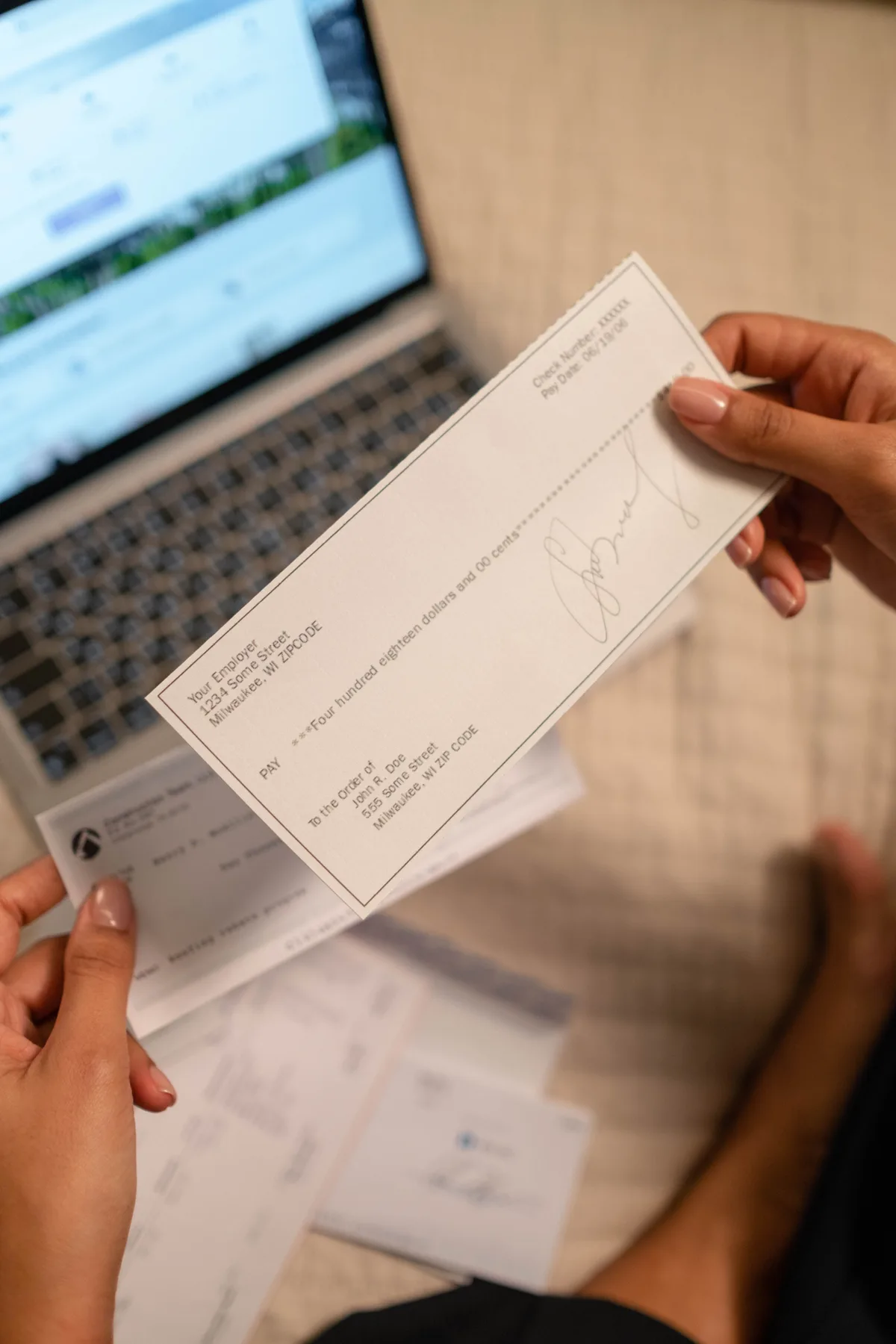
A standard paper check carries several pieces of information. Along the bottom edge, printed in that slightly robotic font, sits a strip called the MICR line, short for magnetic ink character recognition, because the numbers are printed in special ink that check processing machines can read. On most consumer checks this strip holds three numbers: the nine digit routing number that identifies your bank, your account number, and the check number.
People often assume these always run left to right in that exact order, but the layout is not universal. Bank of America's own check ordering guidance notes that the check sequence number can appear either before or after the account number depending on the check design (Bank of America). A useful rule of thumb is that the routing number is the nine digit block, the account number is usually the longer of the remaining numbers, and the check number is typically the short one that also matches the number printed in the top right corner of the check. If you are not certain which number is which, identify the check number separately or confirm your account number with your bank before you rely on it.
It is also worth being clear eyed about what a check shows beyond those numbers. A personal check ordinarily displays your printed name and address, your bank's name, and the check number, in addition to the routing and account numbers. So a voided check does not share only two numbers. Its purpose is to convey the routing and account numbers, but in handing it over you are also revealing your name, address, and bank. That is a good reason to treat it as a sensitive document rather than a throwaway slip of paper.
When you void a check, you deliberately cancel its value as a normal payment while leaving the MICR strip readable. Writing VOID in large letters across the face of the check tells any human or scanner that the document is not meant to be paid in the ordinary way. What remains useful is the printed account data, which is exactly what a payroll department or a billing company needs to send money to you, or to pull an agreed payment from you through the Automated Clearing House, the network that moves most direct deposits and automatic payments in the United States.
In other words, the practical job of a voided check is to answer a single question for the party receiving it: which account, at which bank, should this money flow to or from? The printed numbers are far more reliable than a human copying them onto a form, where a transposed digit can send a paycheck to the wrong place.
Why so many forms ask for one
The most common reason you will be asked for a voided check is to set up direct deposit for a paycheck. Employers want the printed numbers rather than numbers you typed, because a single wrong digit can route your pay to the wrong place or bounce it back with a delay. The same logic applies when you set up automatic payments for a loan, a utility, an insurance premium, or a gym membership. The company wants to confirm the account it will be debiting each month.
You may also see the request when you link accounts between two banks, fund a new brokerage account, or arrange recurring transfers. In every one of these cases the goal is identical. The receiving organization is building an electronic connection to your account and wants a clean, verified copy of the routing and account numbers. A voided check is the cheapest and most familiar way to provide that.
It is worth knowing that a voided check is a convention, not a legal requirement. Nothing in federal payment rules says you must hand one over. Many employers and billers will happily accept a bank issued direct deposit form, a letter from your bank, or numbers entered directly into a secure portal. The voided check simply became the default because paper checks used to be universal. If you want a fuller walkthrough of the enrollment process itself, our guide to setting up direct deposit covers the forms and timing in detail.
How to void a check, step by step
Voiding a check takes less than a minute, and you do not need to call or visit your bank to do it. You simply pull a check from your own checkbook and mark it. The only real skill involved is marking it clearly enough to cancel its payment value while keeping the bottom numbers readable. Here is the sequence recommended by bank guidance on voiding checks (WaFd Bank).
A few extra notes make the difference between a voided check that works and one that causes problems. Use blue or black permanent ink, not pencil and not an erasable pen, so the VOID cannot be lifted off. Make the letters big and obvious, spanning the payee line, the dollar box, and the signature line. Draw a line through any remaining blank fields as well, because WaFd Bank specifically cautions that empty spaces invite a fraudster to try to fill them in and deposit or cash the check. Do not sign it. A signature is never needed on a voided check, and skipping it removes one avenue of misuse. Be clear, though, that no single step makes a voided check impossible to abuse. VOID blocks a normal payment, but it does not guarantee that nobody can alter the check, print a counterfeit using your details, or attempt an unauthorized electronic debit. That is why how you store and deliver the check matters as much as how you mark it.
The one mistake that breaks it
The single most common error is writing VOID straight through the numbers at the bottom. If you obscure the routing or account numbers, the whole point is lost, because those are the digits the recipient needs. Keep your marks above the MICR line. The VOID should dominate the center and upper portion of the check while the bottom strip stays crisp and legible. If in doubt, write VOID a few times across the blank middle of the check rather than one giant stroke corner to corner.
Where your routing and account numbers actually live
Because a voided check exists mainly to share your routing and account numbers, it helps to know exactly what those numbers are and where else you can find them. This matters even more if you plan to type them into a form instead of handing over paper.
One caution is easy to miss and causes a surprising number of rejected deposits. The routing number printed on a deposit slip is sometimes an internal number used by the bank for its own processing, not the standard routing number used for electronic transfers. The IRS specifically warns taxpayers not to pull a routing number from a deposit slip for direct deposit of a refund, and to use a check or confirmed online banking information instead (IRS). The same caution applies to any direct deposit setup. When in doubt, log in to your bank and read the routing and account numbers from the account details screen, where the bank shows the correct electronic routing number. If you want to understand what each digit on a check represents, our breakdown of routing versus account numbers walks through the full anatomy.
No checkbook? Your real alternatives
A growing share of people, especially those with online only accounts, simply do not have paper checks. That is fine. A voided check is one way to verify an account, not the only way. If the form you are filling out insists on a voided check and you have none, start by asking whether an alternative is accepted. Most of the time it is. Here are the common substitutes and how they compare.
If your account came with no checks at all, the cleanest path is usually a bank letter or an official direct deposit form. Call your bank or use secure chat and ask for a direct deposit authorization form or a letter confirming your account. Many banks can generate one inside the app or online portal within minutes, often as a downloadable PDF on bank letterhead that lists your name, account type, routing number, and account number. Some employers and billers will also accept a screenshot of your account details screen, though a formal document tends to raise fewer questions. If you do have a checkbook but it is in a drawer somewhere, voiding one check is still the fastest option of all.
Is handing over a voided check safe?
This is the right question to ask, and the honest answer is mostly yes, with sensible limits. A voided check reveals your routing number and account number, along with your name, address, and bank. Those numbers alone cannot be used to log in to your account, change your password, or wire your balance to a stranger. They are, by design, printed on every check you have ever written to anyone. That is why giving a voided check to a legitimate employer or biller is considered low risk.
At the same time, those details are not nothing. In the wrong hands they can be used to attempt unauthorized ACH debits, or to support an altered or counterfeit check, which is one reason you should treat a voided check like any other sensitive document. The practical rules are simple. Hand it only to a party you trust and have an actual relationship with, such as your employer, your lender, or a company whose service you are deliberately signing up for. Deliver it through a channel the organization controls, like a payroll portal or a named human in accounts payable, rather than a generic email address or a random link. Avoid sending a photo of a voided check over unsecured email or text when you can upload it to a secure system instead.
Two habits add a layer of protection. First, keep a record of the voided check in your check register or a note, including the check number and who received it, so you can reconcile later. Second, turn on account alerts so any unexpected debit shows up immediately. If you ever see a charge you did not authorize, federal rules under the Electronic Fund Transfer Act give you the right to dispute unauthorized ACH debits, and acting quickly protects you most. The faster you report, the stronger your position, which is why monitoring beats hoping.
Voided checks and your tax refund
One place these numbers show up every spring is your tax return. If you want your federal refund by direct deposit, you supply the same routing and account numbers a voided check would carry. The IRS calls direct deposit the fastest and safest way to receive a refund and lets you send it to a bank account, and in many cases to a prepaid card or mobile app that accepts a routing and account number (IRS). This is more than a preference now. Under a federal push to modernize payments, the IRS has moved toward electronic refunds as the standard and is phasing out paper refund checks, which makes getting your deposit details right more important than ever.
You can also split one refund across more than one account. The IRS uses Form 8888 for this, which lets you divide a single refund into as many as three accounts, entering a routing number, account number, account type, and dollar amount for each (IRS Form 8888). As of the December 2025 revision, the form is used only to split a direct deposit across accounts, since the older option to buy paper savings bonds with a refund has been discontinued.
Accuracy is critical here, and it helps to understand what actually happens when a number is wrong, because it is not a simple bounce back to a paper check. Two very different things can occur. If the numbers do not match a valid account and the bank rejects the deposit, the IRS does not automatically print and mail a check. Current IRS guidance explains that it generally issues a notice called CP53E, which holds your refund and gives you a window, described as 30 days, to act through your IRS online account. Within that window you have more than one choice. You can add or correct your direct deposit information so the IRS can try the deposit again, or, under limited exception conditions, you can use your online account to request a paper check instead. If you do not respond, the IRS issues a paper check on its own, which the notice indicates follows after about six weeks (IRS). In other words, a mailed check is not only a last resort after a second rejection or silence; it is also an option you can choose up front if you qualify under those exception conditions. The second possibility is more serious. If a wrong routing and account number happen to match someone else's real account, your refund can be deposited into that stranger's account rather than being rejected at all. Money sent to the wrong valid account is often difficult to recover, which is the real reason to check every digit before you file.
A couple of IRS rules are easy to trip over. You cannot route a refund into someone else's account, including a tax preparer's account to cover fees. And to curb fraud, the IRS limits the number of refunds that can be deposited into a single account or prepaid card to three per year (IRS). For most households none of this is a problem, but it is good to know before you type numbers that will determine where thousands of dollars land.
Put those numbers to work: automating savings
Here is the upside that often goes unmentioned. The same verified account details on a voided check are what let you automate good financial habits. Splitting a direct deposit so that a fixed slice of every paycheck lands in savings before you ever see it is one of the most effective ways to build a cushion, precisely because it removes the monthly decision. Many payroll systems let you send part of your pay to one account and the rest to another, and each account is identified the same way a voided check identifies it.
The math of consistent automatic deposits is quietly powerful. The slider below is a hypothetical illustration, not a forecast or a promise of any particular rate, but it shows how a modest recurring deposit plus interest can move you toward a goal over time. Adjust the inputs to match your own situation and see how the timeline shifts.
If you want to keep tabs on the accounts you connect this way, or compare what different checking and savings accounts actually cost in fees, a personal finance tracking tool such as WalletHub Premium can help you monitor balances and spot charges you did not expect. The point is not the tool itself. It is that once your account numbers are wired into direct deposit and automatic transfers, a little monitoring keeps those connections working for you rather than against you.
Quick answers to lingering doubts
Can you reuse a voided check? It depends on what you mean by reuse. The VOID mark permanently blocks the paper from being cashed or deposited as a normal payment, so you can never reuse it to make a payment, and that is the entire idea. Verification is a different matter. Because a voided check simply conveys your routing and account numbers, a clear copy can often be submitted to more than one recipient to confirm the same unchanged banking details, as long as that recipient is willing to accept a copy rather than an original. A fresh check is not inherently required for every new biller. You only need to void another check, or request another bank letter, when a company insists on an original, when your banking details have changed, or when you simply prefer to hand over a new one. Does voiding a check cost anything? No, it is free, and you do not need to contact your bank. Does the check number matter? For direct deposit and ACH setup, no. The recipient cares about the routing and account numbers, not which check in the sequence you used. Will voiding a check affect your balance? Not at all. No money moves when you void a check, and you do not need to record it as a transaction, though noting it in your register is a smart habit.
What if you make a mistake while voiding it, such as covering a number? Just void another check. Checks are cheap and you have plenty, so there is no reason to submit one that is hard to read. And what if an employer or biller refuses every alternative and demands a voided check you cannot produce? Push back politely and ask for the accounts payable or payroll contact, because a bank letter or official direct deposit form carries the same information and is routinely accepted. In practice, the request for a voided check is rarely a hard wall. It is just the most familiar way to ask for numbers you can supply in several other ways.
The bottom line
A voided check is one of the simplest tools in everyday banking, and one of the most misunderstood. It conveys the routing and account numbers needed to pay you or bill you, while the VOID mark stops the paper from being used as a normal payment. It is not, however, a magic shield. The check still carries your name, address, and bank details, so handle it with care. To make one, pull a check, write VOID in large letters across the face without touching the numbers at the bottom, draw a line through any blanks, skip the signature, and keep a quick record. If you have no checks, a bank letter, an official direct deposit form, or confirmed numbers from your online banking do the same job. Treat the numbers with reasonable care, use secure channels, and watch your account for anything unexpected. Do that, and the small request that once stalled your onboarding becomes a quick step toward getting paid and automating the habits that build your savings.
Banks profit from what their customers do not know.
Every fee, teaser rate, and disclosure is a test you are taking whether you study or not. The Financial IQ Test scores your real money knowledge across 90 tests and shows you the gaps before a bank finds them first.
Test your Financial IQQuestions people ask
Can someone steal money with a voided check?
A voided check shows your routing and account numbers, and those numbers alone cannot be used to log in to your account, change your password, or wire away your balance. They are the same numbers printed on every check you write. The VOID mark stops the check from being paid in the normal way, but it does not rule out someone trying to alter it, create a counterfeit, or attempt an unauthorized electronic debit. So share a voided check only with trusted parties through secure channels, and keep account alerts on so you can dispute anything unexpected quickly.
Do I need to ask my bank to void a check for me?
No. Voiding a check is free and you do it yourself. Pull a blank check from your own checkbook and write VOID across the front in permanent ink. You only need to contact your bank if you have no checks at all, in which case you can request a direct deposit form or a letter confirming your account numbers instead.
Do I have to void a brand new check for every company that asks?
Not necessarily. Voiding permanently blocks that paper from being used as a payment, so you cannot reuse it to pay anyone. But because the check only conveys your routing and account numbers, many recipients will accept a clear copy to verify the same unchanged banking details, which means one voided check can serve more than one biller when copies are accepted. You would void another check or request a fresh bank letter when a company insists on an original, when your banking details have changed, or when you simply prefer to hand over a new one.
What do I do if I do not have any paper checks?
Ask the employer or biller whether they accept an alternative, because most do. Common substitutes include an official direct deposit authorization form, a bank letter on letterhead listing your account details, or numbers you confirm from your online banking account details screen. Many banks can generate the form or letter inside their app or portal within minutes.
Should I write VOID over the numbers at the bottom of the check?
No. The numbers along the bottom sit in the MICR line and include your routing number, account number, and check number, though the order can vary by check design. The recipient needs the routing and account numbers to set up your deposit or payment, so keep your VOID marks above that strip and leave the bottom numbers clearly readable. If you are unsure which number is the account number, confirm it with your bank.
Does a voided check help with my tax refund?
It provides the same routing and account numbers the IRS needs to deposit your refund, and you can split one refund across up to three accounts using IRS Form 8888. Get every digit right. If the numbers are wrong and the deposit is rejected, the IRS generally issues a CP53E notice that holds your refund and gives you about 30 days to correct your banking information online, try the deposit again, or request a paper check under limited exception conditions. If you do not respond, the IRS mails a check on its own. If the wrong numbers happen to match someone else's valid account, your refund can land there instead, and that money is often hard to recover.
Keep reading

Never Pay a Bank Fee Again: The Complete Playbook

CD Ladders Explained: Lock In Rates Without Locking Up Your Life

The Emergency Fund Guide: How Much, Where, and How Fast
The Flourish Letter
One smart money idea each week, charts included. Join free and get the printable 2026 Money Calendar in your welcome email.