Key takeaways
- Kakeibo is a written budgeting ritual created by journalist Hani Motoko in 1904, built around slowing down and recording spending by hand.
- The system sorts every expense into four buckets: needs for survival, wants, culture, and unexpected or extra, which makes overspending visible at a glance.
- Four reflection questions sit at the heart of the method and turn budgeting from a math chore into an honest conversation with yourself about money.
- You run it in two rhythms: a quick weekly check-in to log and tally, and a longer monthly review to compare your goal against reality.
- Kakeibo overlaps with zero-based budgeting and the 50/30/20 rule, but it leans harder on awareness than on rigid percentages.
- It works beautifully for people who overspend on autopilot and less well for those who want full automation or have highly irregular income.
Most budgeting advice asks you to do math. Kakeibo asks you to pay attention. That is the quiet difference that has kept this Japanese method alive for more than a hundred years, long after countless budgeting apps and envelope systems have come and gone. There is no algorithm, no automatic sync, no dashboard that buzzes when you overspend. There is just a notebook, a pen, and a handful of honest questions you ask yourself before you buy something. It sounds almost too simple to work. For a surprising number of people, that simplicity is exactly why it does.
This guide walks through the whole practice. We will cover where kakeibo came from and why it was invented, the philosophy of recording spending by hand, the four categories and the four reflection questions at its core, exactly how to run it week by week and month by month, the pen-and-paper versus app debate, how it stacks up against zero-based budgeting and the 50/30/20 rule, and a realistic month of numbers so you can see the gears turn. By the end you will know whether kakeibo is worth your time, and how to start tonight if it is.
Where Kakeibo Came From
Kakeibo, which translates roughly to household account book, was created in 1904 by a woman named Hani Motoko. She is widely remembered as Japan's first female journalist, and she designed kakeibo for an audience that the financial world of her era almost completely ignored: ordinary homemakers running a household budget on a single income. Her idea was radical in its plainness. Give women a structured place to write down what came in, what went out, and what they hoped to save, and money stops being a vague source of anxiety and becomes something you can actually see and steer.
The method spread through Japanese households for generations, passed down the way a good recipe is, and it never really needed updating. The reason it survived is not nostalgia. It is that the core insight holds up under any economy: people spend differently when they are forced to slow down and notice. Over a century later, that is still the entire engine of the thing. Everything else is just structure built around the act of paying attention.
The Philosophy: Why Writing It Down by Hand Matters
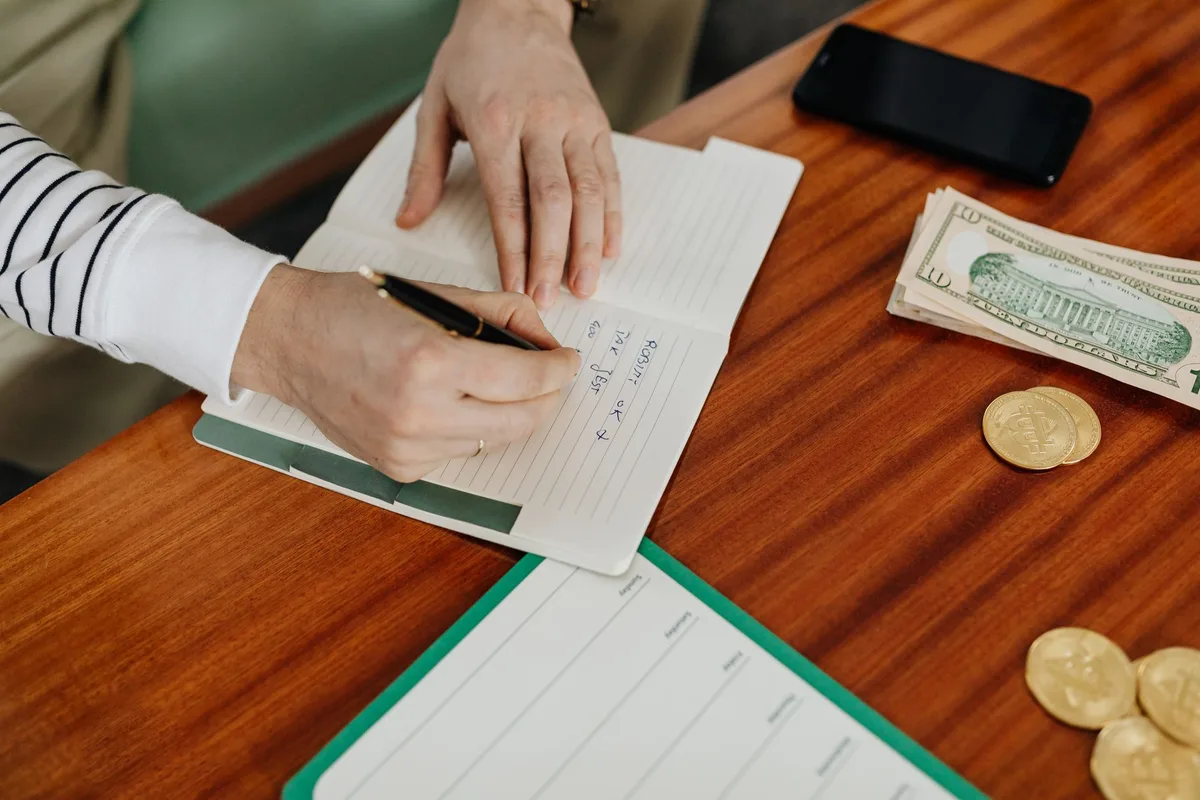
Here is the part that trips people up at first. Kakeibo deliberately makes recording your spending a little inconvenient. You write it by hand. You add it up yourself. You sit with it. In a world of one-tap payments and apps that categorize your latte before you have finished drinking it, this feels like going backward. It is supposed to.
The friction is the feature. When you swipe a card, the money is abstract and the moment is over in a second. When you later write that thirty-eight dollars in a notebook under a category you chose, you have to confront it twice: once when you spend, and once when you record. That second confrontation is where awareness lives. People who keep a kakeibo often report the same surprise, which is that they simply buy less, not because a rule forbade it, but because the act of writing it down made the spending real. The notebook is a mirror, not a cage.
The goal of kakeibo is not to punish yourself for spending. It is to spend with intention, so that the money you part with actually buys the life you want.
This is also why kakeibo pairs so well with a separation between needs and wants. Researchers who study household finances, including the work behind the Federal Reserve's annual survey of economic well-being, consistently find that financial stress is less about income alone and more about the gap between spending and awareness. Kakeibo closes that gap by hand, one entry at a time.
The Four Categories
Every expense in kakeibo goes into one of four buckets. The names vary slightly between translations, but the spirit is consistent, and the four-way split is what gives the method its diagnostic power. Three categories alone, the way the 50/30/20 rule works, cannot tell you why a good month went sideways. Four can.
The first category is needs, sometimes called survival. This is the non-negotiable spending that keeps your life running: rent or mortgage, groceries, utilities, transportation to work, insurance, minimum debt payments, basic medical costs. If skipping it would create a real problem, it lives here.
The second is wants, the optional spending you choose for enjoyment or convenience. Dining out, the second streaming service, new clothes you do not strictly need, the upgrade from the basic version. None of this is bad. The point of naming it is simply to see how much of it there is.
The third category is the one that makes kakeibo special: culture, sometimes called enrichment. This is money spent on growing, learning, and experiencing. Books, concerts, museum tickets, a class, a trip that broadens you. Most budgeting systems lump this into wants, which quietly teaches you that personal growth is a guilty pleasure. Kakeibo gives it its own line on purpose, because spending on who you are becoming is different from spending on a whim.
The fourth is unexpected or extra. These are the irregular, lumpy costs that wreck a tidy budget: a car repair, a birthday gift, a medical copay, the wedding you forgot was this month. Giving them their own category does something clever. It stops a surprise expense from feeling like a personal failure and starts treating it as a normal, recurring fact of life that deserves its own plan.
The Four Questions
If the categories are the skeleton of kakeibo, the four reflection questions are the heart. You ask them at the start of each month and revisit them at the end. They are not rhetorical. You write the answers down. This is the step most people skip and the step that actually changes behavior.
The first question is how much money do you have. Not roughly, not vibes. You write down your actual expected income for the month after taxes. This sounds obvious, yet a great many people genuinely do not know this number, and you cannot steer what you cannot see.
The second is how much would you like to save. Notice the order. In kakeibo you decide your savings goal before you plan your spending, which flips the usual habit of saving whatever happens to be left over, which is usually nothing. You write a specific number, and that number gets subtracted from your income before you allocate a single dollar to anything else.
The third question is how much are you actually spending. This is the running tally you keep all month across the four categories. It is the reality check against the plan you set at the start.
The fourth, and most important, is how can you improve. At the end of the month you compare your plan to your reality and ask, honestly, what went well and what did not, and what one change you will try next month. This is where kakeibo stops being a ledger and becomes a practice. The improvement is always small and specific: pack lunch three days a week, cancel the subscription you forgot about, move the savings transfer to payday so it happens before the spending starts.
How to Run Kakeibo Week by Week and Month by Month
Kakeibo runs on two rhythms, and confusing them is the most common reason beginners give up. The daily and weekly rhythm is about capture. The monthly rhythm is about reflection. Here is the full cycle, start to finish.
At the start of the month, you sit down and answer the first two questions. Write your expected take-home income. Subtract your fixed costs, the rent and utilities and insurance that barely change. Subtract your savings goal next, before anything fun. What is left is your spending money for the month, which you can roughly divide across the four categories as targets, not hard walls.
During the month, you log. Every expense gets written down, ideally the same day, sorted into one of the four categories. Some people carry a small notebook, some snap a photo of receipts and enter them at night, some keep a single running note on their phone. The method does not care about the tool. It cares that you do it consistently and that you feel each entry a little.
Once a week, you tally. This is a five to ten minute ritual. Add up what you have spent in each category so far, compare it to where you should be at this point in the month, and notice anything surprising. The weekly check-in is what keeps a small overspend in week one from becoming a blown budget by week four. It is the early warning system.
At the end of the month, you review. This is the longest and most valuable session. You total each category, compare the totals to your starting plan, and answer the fourth question in writing: how can you improve. You also confirm whether you actually hit your savings goal. Then you carry one concrete lesson into the next month and start the cycle again. Over a few months, the reviews start to rhyme, and you begin to see your real patterns instead of guessing at them.
Pen and Paper or an App?
This is the debate that splits the kakeibo community, and the honest answer is that both can work, but they are not equivalent. The original method is handwritten for a reason that is psychological, not technological. Writing is slow, and slow is the point.
The case for pen and paper is the friction itself. A physical notebook forces the pause that creates awareness, it has no notifications pulling you elsewhere, and the simple act of choosing which of the four categories a purchase belongs to makes you think about the purchase. Many longtime practitioners swear the handwriting is the whole point and that the day they switched to an app, the magic quietly leaked out.
The case for digital is friction of a different kind: the friction of giving up. If a paper notebook means you stop logging by week two, then a spreadsheet or a notes app that you will actually keep using beats a beautiful journal that sits in a drawer. The trick, if you go digital, is to preserve the moment of reflection. Resist apps that auto-categorize everything for you, because outsourcing the categorization outsources the very awareness you came for. A simple spreadsheet with the four categories and a monthly review tab keeps the spirit intact. Government resources like the spending tracker tools from the Consumer Financial Protection Bureau can help here, since they are built around manual entry and reflection rather than automation.
A reasonable middle path is to log on your phone in the moment for convenience, then do the weekly tally and monthly review by hand in a notebook, where the reflection actually happens. You get the capture of digital and the thoughtfulness of paper.
Kakeibo Versus Zero-Based and 50/30/20
Kakeibo does not exist in a vacuum, and it is worth seeing exactly where it sits next to the two budgeting frameworks most Americans have heard of. They are not rivals so much as different tools for different temperaments.
Zero-based budgeting gives every single dollar a job until your income minus your assignments equals zero. It is precise, powerful, and demanding. Kakeibo shares the idea of intentional allocation, since you assign your savings and fixed costs up front, but it is gentler about the rest. It uses category targets rather than accounting for every last dollar, which makes it more forgiving and more sustainable for people who find strict zero-based budgeting exhausting.
The 50/30/20 rule is the opposite extreme: a simple top-down split of take-home pay into roughly half for needs, thirty percent for wants, and twenty percent for savings and debt. It is easy to remember and easy to start. Where it stays quiet, kakeibo speaks. The 50/30/20 rule tells you the target percentages but offers no built-in ritual for noticing why you missed them. Kakeibo's weekly tally and monthly reflection are precisely that missing feedback loop. In fact, plenty of people run a hybrid: they use 50/30/20 as a rough target for the percentages, and kakeibo as the daily practice that keeps them honest about hitting it. The CFPB's own budgeting guidance leans on this same combination of setting targets and then tracking against them.
Who Kakeibo Works For, and Who Should Skip It
No budgeting method is universal, and pretending otherwise is how people end up blaming themselves for a tool that simply did not fit. Kakeibo has a clear sweet spot.
It works wonderfully for people who overspend on autopilot, who reach the end of the month wondering where it all went. The handwritten log is custom-built to cure exactly that fog. It also suits people who find rigid budgets demoralizing and have abandoned spreadsheets before, because kakeibo's reflective, forgiving rhythm feels less like a diet and more like a journal. And it fits anyone who wants a calmer relationship with money, since the practice is as much about mindset as math.
It is a poorer fit in a few honest cases. If you genuinely want full automation and will never log a purchase by hand, kakeibo's core mechanism is just not for you, and a syncing app with strong tracking will serve you better. If your income is wildly irregular, kakeibo still works but needs adaptation, usually by planning each month on a conservative low estimate and treating overages as bonuses. And if you are in a debt crisis where the real problem is income falling short of essential bills, no notebook fixes that. The right first move there is the kind of triage the CFPB describes for people behind on bills, not a budgeting ritual. Kakeibo shines once you have enough margin to make choices, which is most people, most of the time, but not everyone.
A Realistic Month in Numbers
Let us walk through a single month for an invented but realistic household to see how the pieces fit. Meet a person bringing home about $4,000 a month after taxes. At the start of the month, they answer the first two questions. Income is $4,000. They would like to save $600. Their fixed costs, which they treat as a slice of needs, run about $1,950 for rent, utilities, insurance, phone, and minimum debt payments.
The math at the start of the month is straightforward. Take the $4,000 income, set aside the $600 savings goal first, and subtract the $1,950 in fixed costs. That leaves $1,450 of flexible spending money to spread across the four categories for the month. They sketch rough targets: about $500 more for variable needs like groceries and gas, $450 for wants, $250 for culture, and a $250 cushion for unexpected or extra.
Then life happens, and they log it. Here is how the four categories actually filled in by the end of the month, plotted against those starting targets.
The weekly tallies caught a problem early. By the end of week two, dining out had already eaten most of the monthly wants target, so they pulled back and cooked at home for the back half of the month. Wants still came in a little high at $510 against a $450 target. The unexpected category took a real hit when the car needed a $300 brake repair, which is exactly the kind of lumpy cost that category exists to absorb. Because it had its own line, the repair felt like a planned-for fact of life rather than a budget-destroying emergency.
Now the monthly review and the fourth question, how can you improve. Add it up: variable needs landed at $480, wants at $510, culture at $190, and unexpected at $300, for $1,480 of flexible spending against the $1,450 plan. They overshot the flexible budget by $30, mostly from the car repair offsetting the dining pullback. Crucially, because the $600 savings transfer happened on payday before any spending, the savings goal was still met in full. The improvement they write down for next month is specific and small: raise the unexpected cushion to about $300 since car-and-gift months keep recurring, and move one streaming subscription to the chopping block to claw back the wants overage. That single page of honest reflection, repeated monthly, is the entire method working as designed.
Notice what kakeibo did and did not do here. It did not magically create more money. What it did was make every dollar visible, protect the savings goal by funding it first, absorb a surprise without drama, and surface one concrete fix for next month. Repeat that loop for six months and the patterns become obvious, the surprises get smaller, and the savings number tends to climb. That is the quiet promise Hani Motoko built into a notebook in 1904, and it still pays out today.
Starting Tonight
You do not need an app, a class, or the perfect notebook to begin. Grab any blank book or open a fresh note. Write down your expected income for this month. Write the amount you would like to save, and make it a real number you will fund first. List your fixed costs and subtract them. Then, starting tomorrow, write down every single thing you spend and drop it into one of the four buckets: needs, wants, culture, or unexpected. Tally once a week. At month's end, ask yourself how you can improve, and write the answer down where you will see it.
That is the whole practice. It is over a century old, it costs nothing, and it asks only that you slow down and look. For a method this plain, kakeibo has an unusual way of changing how people feel about their money, not by restricting them, but by finally letting them see clearly what they were doing all along.
Every budget has two sides. Income is the one with no ceiling.
You can only cut expenses so far. The income line is the one that can grow without limit, and it grows fastest when your career fits your cognitive strengths. RealWorldCareers shows you where that fit is.
Find the career your brain was built forQuestions people ask
How do you actually pronounce kakeibo?
It is roughly kah-keh-boh, with three short even syllables and no strong stress on any one of them. The word translates loosely to household financial ledger or household account book. Do not worry about getting the pronunciation perfect. The practice matters far more than the name.
Do I have to use pen and paper, or can I use an app?
You can use either, and plenty of people use a spreadsheet or a notes app. The traditional method is handwritten on purpose, because the friction of writing each expense by hand is what creates the pause that makes you think. If you go digital, try to keep that moment of reflection rather than letting an app auto-categorize everything for you.
How is kakeibo different from the 50/30/20 rule?
The 50/30/20 rule splits your take-home pay into fixed percentages for needs, wants, and savings, and it is mostly a top-down target. Kakeibo uses four spending categories instead of three and does not lock you into preset percentages. Its real engine is the weekly and monthly reflection, where you write down what you noticed and what you want to change.
How much time does kakeibo take each week?
Logging takes a minute or two a day if you do it as you spend, or about ten minutes if you batch a week of receipts at once. The weekly tally adds maybe five to ten minutes. The monthly review is the longest part, usually fifteen to thirty minutes, because that is where you compare your plan to reality and decide what to adjust.
Can kakeibo work if my income changes month to month?
It can, but it takes more care. Because kakeibo starts each month by subtracting fixed costs and a savings goal from expected income, irregular earners often base the month on a conservative low estimate and treat extra income as a bonus. Many freelancers pair kakeibo with a separate buffer account to smooth out the lean months.
Is kakeibo a substitute for an emergency fund or investing?
No. Kakeibo is a spending awareness and savings habit, not a complete financial plan. It helps you free up money and decide how much to set aside, but where that money goes, such as an emergency fund, retirement account, or debt payoff, is a separate decision. Think of kakeibo as the engine that generates savings, not the destination.
Keep reading
The 50/30/20 Budget With Real 2026 Numbers and Examples

How to Budget as a Couple Without Fighting About Money

How to Build a Budget That Actually Sticks This Time
The Flourish Letter
One smart money idea each week, charts included. Join free and get the printable 2026 Money Calendar in your welcome email.