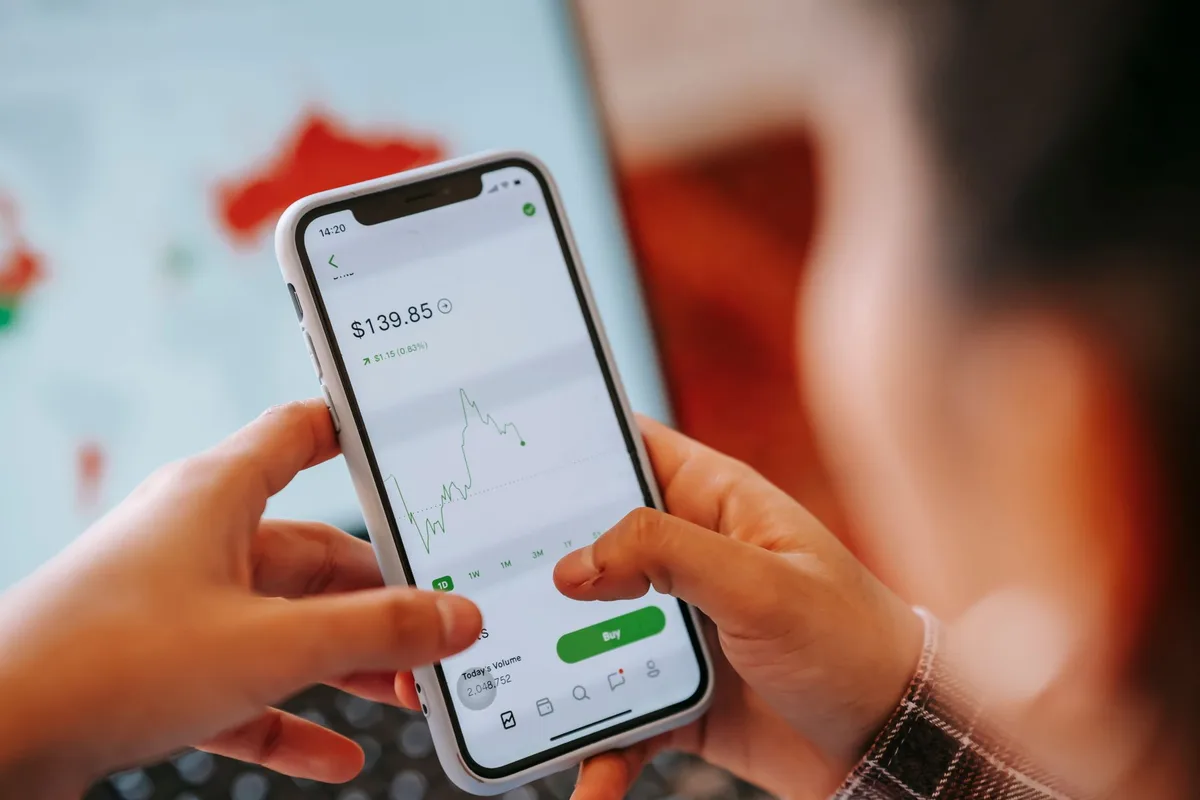
Key takeaways
- Opening a brokerage account is free, takes about fifteen minutes online, and most major brokers now have no account minimum and zero commission on US stocks.
- A market order buys at the next available price right now, while a limit order only fills at the price you set or better, which is the safer default for beginners.
- Fractional shares let you buy a slice of a pricey stock with as little as one dollar, so a high share price is no longer a reason to stay on the sidelines.
- For most beginners a single low-cost index fund is a calmer, more diversified first purchase than betting on one company's stock.
- Dollar-cost averaging, buying a fixed amount on a regular schedule, removes the pressure to time the market perfectly and is easy to automate.
- The account type you choose, taxable brokerage versus IRA, changes your taxes far more than which stock you pick in your first year.
The first stock purchase has a strange reputation. People imagine a frantic trading floor, a wall of red and green numbers, and a single wrong click that wipes out the rent. The reality is closer to ordering something online. You set up an account, you type in how much you want to buy, you click a button, and a few seconds later you own a piece of a company. The hard part is almost never the mechanics. The hard part is the noise in your head telling you that you will mess it up. This guide is here to quiet that noise by showing you exactly what happens at every step, in plain language, so the first purchase feels like the small, ordinary thing it actually is.
We will cover the whole path: what owning a stock even means, how to open and fund a brokerage account, the difference between market and limit orders, how fractional shares changed the game for beginners, a line-by-line walkthrough of a real order ticket, what happens after you click buy, the honest answer on what to buy first, how dollar-cost averaging takes the pressure off, the tax and account-type basics, and the handful of beginner mistakes worth dodging. By the end you will be able to do this with steady hands.
What You Are Actually Buying
A share of stock is a small slice of ownership in a real company. Buy one share of a company and you own a tiny fraction of everything it has: its buildings, its brand, its future profits. If the company grows and becomes more valuable, your slice usually becomes more valuable too. If it stumbles, your slice can shrink. That is the entire deal. There is no lending, no fixed payback, no guarantee. You are a part owner, sharing in the upside and the downside.
Companies can also choose to pay out a portion of their profits to shareholders as a dividend, usually every quarter. Many fast-growing companies pay no dividend at all and reinvest everything back into the business, which is perfectly normal. So your return as a stock owner comes from two places: the share price rising over time, and any dividends paid along the way. Over long stretches of US history, broad baskets of stocks have rewarded patient owners, though never in a straight line and never with a promise.
That chart of the broad US market is worth sitting with for a moment. The line is jagged. There are stretches where it falls hard and stays down for what feels like forever. The reason long-term investors stay invested anyway is that the overall direction across decades has been up, and nobody has reliably predicted the dips in advance. That is the temperament the rest of this guide is built around: own good things, and give them time.
Step One: Open a Brokerage Account
You cannot buy a stock directly from a company in most cases. You buy through a broker, a licensed firm that connects you to the stock market and holds your shares for you. Opening an account with a major online broker is free, and in 2026 the big names charge no commission to trade US stocks and require no minimum balance to open. The application takes about fifteen minutes and looks a lot like opening a bank account online.
You will need a few things ready: your Social Security number, a government ID, your employer information, and a bank account to transfer money from. The broker is required by law to ask these questions to verify who you are. The application will also ask about your income, your net worth, and your investing experience. Answer honestly. These questions are mostly about regulatory suitability, not a test you can fail.
How do you pick a broker? For a first stock, the differences between the major firms matter far less than beginners fear. Confirm a few non-negotiables and you are in good shape.
The single most important box to check is that the broker is a member of FINRA and SIPC. FINRA membership means the firm is overseen by the industry regulator. SIPC membership means that if the brokerage firm itself were to fail, your securities are protected up to $500,000, with a $250,000 sub-limit for cash. To be clear, SIPC does not protect you from your stock simply going down in value. That is the risk you signed up for as an owner. It protects you from the rare event of the firm collapsing and your assets going missing.
Step Two: Fund the Account
Once the account is open, you move money in, almost always by linking your checking account and pulling cash over by electronic transfer, known as an ACH transfer. It is free and usually lands within one to three business days, though many brokers let you trade against a pending deposit right away. Some people fund with a small amount the first time, fifty or a hundred dollars, just to walk through the whole process once without nerves. That is a smart move. There is no rule that your first purchase has to be large.
Before that money goes in, make sure it passes one test: it should be money you will not need for at least three to five years. Stocks can drop sharply and stay down for a while, so cash earmarked for next year's rent, a wedding, or an emergency fund does not belong here. That short-term money belongs somewhere stable, like {{AFF_LINK_HYSA}} a high-yield savings account, where the balance does not bounce around. Investing money you might need soon is the most common way beginners get forced to sell at the worst possible moment.
Step Three: Understand Order Types Before You Click
This is the step that intimidates people most, and it is genuinely the only piece of jargon you must learn before buying. When you place an order, you tell the broker how you want it filled. The two types that matter for a beginner are the market order and the limit order.
A market order says, buy this right now at whatever the going price is. It fills almost instantly. The catch is that the price can move a hair between when you click and when it fills, so on a fast-moving or thinly traded stock you might pay slightly more than the number you saw. A limit order says, buy this only at my price or better. You set a maximum you are willing to pay. It protects you from surprises, but if the stock never trades at your price, the order simply does not fill.
Here is the practical rule most educators give beginners. For a large, heavily traded stock or a major index fund, a market order is usually fine because the price barely moves second to second. If you want a little extra control or you are buying something less liquid, place a limit order a few cents above the current asking price. That gives you a near-instant fill while capping the worst case. There are fancier order types, like stop orders, but you do not need them to buy your first share, and using them by accident is a classic beginner stumble.
Step Four: Fractional Shares Changed Everything
Not long ago, if a single share of a company cost five hundred dollars, you needed five hundred dollars to own any of it. That kept a lot of beginners out of the companies they used and admired every day. Fractional shares fixed this. Most major brokers now let you buy a slice of a share by dollar amount. You type in that you want twenty five dollars of a stock, and you get whatever fraction of a share that buys, carried out to several decimal places.
This matters for two reasons beyond simple access. First, it lets you put a round, plannable number to work, like one hundred dollars a month, rather than being forced into awkward whole-share amounts. Second, it makes real diversification possible on a small budget, because you can spread two hundred dollars across several holdings instead of being able to afford only one. The one thing to check: fractional shares can be slightly less flexible to transfer to another broker later, and they are usually bought with market orders rather than limit orders. Neither is a real problem for a long-term beginner.
Step Five: A Line-by-Line Walk Through the Order Ticket
Now the moment itself. When you go to buy, the broker shows you an order ticket, a short form with a few fields. It looks busier than it is. Here is every field you will see and what to put in each one.
Walk through a concrete example. Say you want to put one hundred dollars into a broad US index fund that trades at fifty dollars a share. You search the fund's ticker, which is its short stock symbol, a handful of letters. You choose Buy. You enter either two shares, which is one hundred dollars at fifty dollars each, or if your broker supports dollar-based fractional buys, you simply enter one hundred dollars. You select your order type, a market order is reasonable here for a large fund. You leave the time-in-force on the default, usually Day, meaning the order is good until the market closes today. You review the estimated cost, and you click Place Order. The confirmation screen tells you the order was received. That is it. You are an investor.
One small note on timing. The US stock market is open from 9:30 in the morning to 4:00 in the afternoon Eastern time on weekdays. If you place an order overnight or on a weekend, it queues up and executes when the market next opens. Prices at the open can be jumpy, which is one more reason a limit order is a comfortable choice if you are placing orders outside market hours.
Step Six: What Happens After You Click Buy
The instant your order fills, you own the shares. They show up in your account, and from that moment their value rises and falls with the market. There is, however, a behind-the-scenes step called settlement. As of 2024, US stock trades settle on a T plus 1 basis, meaning the official exchange of cash for shares completes one business day after the trade date. For a beginner who is buying to hold, settlement is mostly trivia. It only becomes relevant if you try to sell and immediately withdraw the cash, or rapidly buy and sell the same money in a regular cash account, which can trigger a good-faith violation.
After settling in, the best thing most new investors can do is close the app. Checking a single stock's price three times a day is a recipe for anxiety and for selling out of boredom or fear. The plan you make calmly when buying is almost always wiser than the impulse you feel watching a red number on a Tuesday.
The Honest Answer: What Should You Buy First?
This is where a lot of guides go quiet, so let us be direct. Buying a single company's stock as your very first investment is exciting, and there is real educational value in owning a piece of a business you believe in. But putting all your money into one stock means your outcome rides entirely on that one company. Even great companies have brutal years, and beginners tend to pick based on familiarity rather than analysis, which is not the same as picking well.
For that reason, many educators suggest a different first purchase: a low-cost, broadly diversified index fund. An index fund holds hundreds or thousands of companies at once, so a disaster at any single one is a rounding error in your total. You are buying the whole field instead of betting on one runner. It is, frankly, a less thrilling first purchase, and that is part of the point. Investing that works tends to be a little boring.
None of this means single stocks are off-limits. A reasonable middle path many beginners use is to put the bulk of their money in a broad index fund and keep a small slice, the amount they could lose entirely without losing sleep, for one or two individual stocks they want to learn from. That way you get the education of owning a single company and the safety of broad diversification at the same time. The mistake is not owning a single stock. The mistake is making one company your entire plan.
Dollar-Cost Averaging: The Pressure Valve
New investors burn enormous energy worrying about whether today is a good day to buy. Dollar-cost averaging is the simple habit that makes that worry mostly irrelevant. Instead of trying to pick the perfect moment with a lump sum, you invest a fixed amount on a regular schedule, say one hundred dollars on the first of every month, no matter what the price is doing.
The mechanics quietly help you. When prices are high, your fixed dollar amount buys fewer shares. When prices are low, the same amount buys more shares. Over time this means you naturally buy more when things are cheap and less when things are pricey, without having to make a single judgment call. Just as importantly, automating the purchase removes the emotional decision entirely. Most brokers let you set up a recurring investment that runs on its own, which turns investing from a nerve-wracking event into a background process. For a beginner, the value is less about squeezing out extra return and more about actually staying in the game through the scary stretches.
Try the sliders above with your own numbers. A modest start plus a steady monthly habit, given enough years, tends to do far more heavy lifting than any single clever stock pick. The growth is illustrative, not a promise, and real returns will be bumpier. But the shape of the lesson holds: time in the market and consistency matter more than perfect timing.
Taxes and Account Types, the Short Version
Where you hold your stocks changes your tax bill more than almost anything else you will do in your first year, so it is worth sixty seconds of attention. There are two broad homes for your investments.
A regular taxable brokerage account is the flexible one. You can put in any amount, take money out any time, and there are no special rules. The trade-off is that you owe taxes along the way: tax on dividends in the year you receive them, and capital gains tax when you sell a holding for more than you paid. Crucially, buying a stock is never a taxable event, and neither is watching it rise. Tax only shows up when you sell at a gain or collect a dividend. If you hold an investment longer than one year before selling, the profit is usually taxed at lower long-term capital gains rates rather than as ordinary income, which is a real reward for patience.
An IRA, or individual retirement account, is the tax-advantaged one, built specifically for retirement money. Inside an IRA your investments can grow without yearly taxes on gains and dividends. The trade-off is access: the money is meant to stay put until retirement age, and pulling it out early usually triggers taxes and a penalty. There are annual contribution limits as well. The common beginner approach is to use a taxable account for goals along the way and an IRA for money you are deliberately setting aside for retirement. If your employer offers a 401k with a match, that is often the very first place to invest, because the match is essentially free money, but that is a topic of its own.
Common Beginner Mistakes, and How to Sidestep Them
Investing money you will need soon. The biggest one. Money for next year's expenses or your emergency fund does not belong in stocks, because a downturn can force you to sell at a loss exactly when you need the cash. Keep short-term money liquid and only invest what can sit for years.
Checking the price constantly. Watching a single holding tick up and down all day breeds panic selling and gleeful overbuying, both of which hurt returns. A calmer schedule, checking monthly or quarterly, matches the time horizon of a long-term investor.
Confusing a low share price with a bargain. A stock at four dollars is not cheaper than one at four hundred dollars in any meaningful sense. Price per share tells you almost nothing about whether a company is a good value. Beginners often pile into low-priced stocks for exactly the wrong reason.
Going all-in on one exciting company. Concentrating everything in a single stock, especially a hyped one you heard about secondhand, is how beginners take losses they cannot recover from quickly. Diversify first, speculate second, and only with money you can afford to lose.
Trying to time the market. Waiting on the sidelines for the perfect entry point usually means missing months or years of growth while earning nothing. A steady dollar-cost averaging plan beats a clever timing instinct for almost everyone, almost always.
Selling in a panic. The worst losses are often locked in by selling during a scary drop. Downturns are normal and temporary for diversified holdings. The investors who do best are frequently the ones who simply did nothing while others rushed for the exits.
That is the entire process, start to finish. Open an account, fund it with money you will not need soon, learn the two order types, start small, lean toward broad diversification, automate your buying, and then mostly leave it alone. Your first share will feel like a milestone, and it should. But the real skill you are building is not picking the right stock on day one. It is the patience to let ordinary, boring, consistent investing do its quiet work over years.
Most investors cannot pass a basic money test. Can you?
The market charges tuition for every gap in your knowledge. The Financial IQ Test measures what you actually know across investing, banking, credit, and retirement, then shows you exactly which gaps to close before they get expensive.
Test your Financial IQQuestions people ask
How much money do I need to buy my first stock?
Less than you think. Most major brokers have no account minimum, and with fractional shares you can buy a slice of almost any stock for as little as one dollar or five dollars. The bigger question is not how little you can start with but whether the money is truly extra cash you will not need for several years.
Is my money safe at an online brokerage?
Your account is protected by SIPC, which covers up to $500,000 in securities, including a $250,000 limit for cash, if the brokerage firm itself fails. SIPC does not protect you from your investments losing value in the market. Stick with well-known brokers that are members of FINRA and SIPC and you have removed the firm-failure worry.
Should my first investment be a single stock or an index fund?
Many educators lean toward a broad index fund for a true beginner because it spreads your money across hundreds of companies at once, so one bad year at one company does not sink you. Buying a single stock is a fine way to learn, but keep that first single-stock purchase small enough that a total loss would only sting, not hurt.
What is the difference between a market order and a limit order?
A market order tells the broker to buy at the best price available immediately, so it fills fast but you do not control the exact price. A limit order sets the most you are willing to pay and only fills at that price or lower. For a beginner buying a popular stock, a limit order a few cents above the current price gives you both a quick fill and protection from surprises.
When does the money actually leave my account after I buy?
US stock trades settle one business day after the trade date, a timeline regulators call T plus 1 as of 2024. You own the shares the moment the order fills, but the cash and shares officially change hands the next business day. This rarely matters for a buy-and-hold beginner.
Do I owe taxes just for buying a stock?
No. Buying creates no tax. You owe tax only when you sell at a gain, called a capital gain, or when a stock pays you a dividend. Holding a winning stock for more than a year before selling usually qualifies the gain for lower long-term capital gains rates, which is one reason patience is rewarded.
Keep reading

How to Choose a Brokerage Account in 2026: A Practical Guide
Dividend Investing for Beginners: Income You Can Actually See
Dollar-Cost Averaging: The Math, the Myths, and When It Wins
The Flourish Letter
One smart money idea each week, charts included. Join free and get the printable 2026 Money Calendar in your welcome email.