
Key takeaways
- A stock chart is a picture of price over time, and learning to read one is mostly about learning a handful of simple parts.
- Line charts show the big picture, while candlesticks pack four prices into each bar: the open, high, low, and close.
- Volume, support and resistance, trend lines, and moving averages add context, but none of them predict the future with certainty.
- Price is what the market charges today, and value is what a business is actually worth, and the two can drift apart for a long time.
- For most long-term investors, low-cost index funds and patience matter far more than any chart pattern you will ever learn.
The first time you open a stock chart, it can feel like staring at a heart monitor in a language you do not speak. There are spiky red and green bars, squiggly lines crossing each other, numbers stacked along the sides, and little buttons promising you can zoom from one day to ten years. It looks like something you are supposed to already understand. You do not, and that is completely normal.
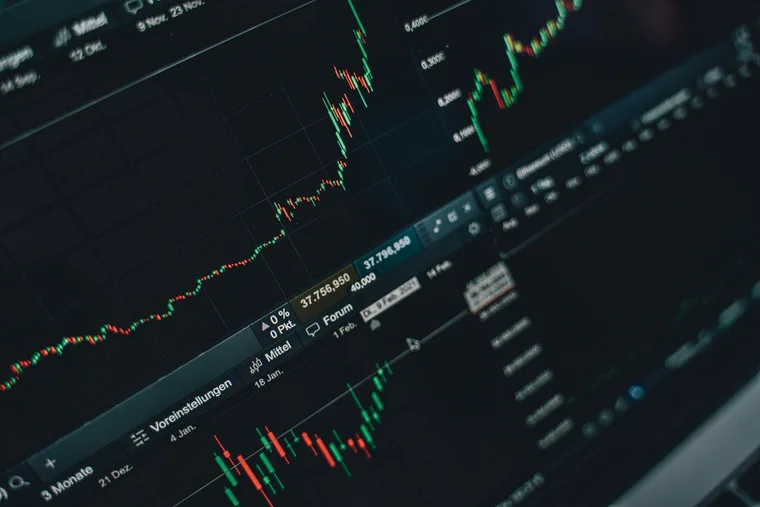
Here is the good news. A stock chart is just a picture of one thing: the price of something over time. Almost everything else on the screen is added context that helps you read that picture more carefully. Once you learn the handful of parts, charts stop looking like a secret code and start looking like what they are, which is a running record of what buyers and sellers have agreed to pay.
This guide will teach you to read a stock chart as a calm, curious long-term investor, not as a frantic day trader. We will cover line and candlestick charts, what a single candle actually tells you, timeframes, volume, support and resistance, moving averages, trend lines, and a few common patterns explained in plain words. We will also talk honestly about the difference between price and value, and about why, for most people building wealth slowly, chart reading matters far less than simply owning low-cost index funds and staying invested. This is education, not advice, and there is no product to buy at the end. Just understanding.
What a stock chart actually is
Strip away the colors and tools, and a stock chart has two axes. The horizontal axis is time, moving from the past on the left to the present on the right. The vertical axis is price, usually in dollars per share, with lower prices near the bottom and higher prices near the top. Every point on the chart answers one question: at this moment in time, what was the price?
That price is not handed down by some authority. It is simply the most recent amount a buyer and a seller agreed on. When more people want to buy than sell, price tends to rise. When more people want to sell, it tends to fall. A stock chart is the visible trail of millions of those tiny agreements, stitched together into a line or a series of bars.
Before we go further, it helps to see the kind of long-view picture that calms beginners down. Below is a real, live chart of the S&P 500 index over the past year. The S&P 500 tracks about 500 large American companies and is a common stand-in for the overall US stock market. Watch how it moves, because everything we discuss next is just a way of describing motion like this.
Notice that the line is not smooth. It climbs, dips, stalls, and recovers. That jaggedness is the normal texture of markets. Reading a chart well is largely about learning not to panic at the small wiggles while staying aware of the bigger direction.
Line charts versus candlestick charts
The two chart styles you will meet first are line charts and candlestick charts. They show the same underlying prices, but they package the information very differently, and knowing when to use each one is half the battle.
A line chart takes one price per period, almost always the closing price, and connects those dots into a single continuous line. Because it ignores the intraday ups and downs and shows only where price settled at the end of each day, a line chart is wonderfully clean. For a beginner trying to answer the simple question, is this generally going up or down over the past year, a line chart is often the best tool there is. It removes noise and shows the shape of the trend.
A candlestick chart shows much more for each period. Instead of a single dot, each day or week gets its own little candle that records four prices at once: where it opened, the highest it traded, the lowest it traded, and where it closed. Candlesticks reward closer study and are popular with active traders, but they can overwhelm a newcomer who only wanted to know the direction. There is no shame in starting with line charts and graduating to candles when you are ready.
Here is a side-by-side comparison of the two styles so you can decide which fits the question you are asking.
A good habit is to flip between the two. Use a line chart to grasp the long arc, then switch to candlesticks when you want to inspect a specific stretch in detail. Neither one is more correct. They are different lenses on the same prices.
Reading a single candlestick
Because candlesticks carry so much information, they deserve their own walkthrough. Each candle covers one slice of time. On a daily chart, one candle is one trading day. On a weekly chart, one candle is one week. The candle has two parts: a thick middle called the body, and thin lines above and below called wicks or shadows.
The body spans the distance between the opening price and the closing price. If the stock closed higher than it opened, the body is typically shown in green or white, and that period is considered an up period. If it closed lower than it opened, the body is red or black, marking a down period. The wicks stretch out to the highest and lowest prices reached during that period, even if price did not finish there. A long upper wick means buyers pushed the price up but could not hold it. A long lower wick means sellers drove it down but buyers fought back by the close.
So a single candle tells a small story. A tall green body with short wicks says the period opened low, climbed steadily, and closed near its high with conviction. A tiny body with long wicks on both sides says buyers and sellers wrestled all period and ended near where they started, which signals indecision. The table below breaks down the four prices and the candle anatomy so you can decode any candle you meet.
You do not need to memorize exotic candle names to benefit from this. Just remembering that the body shows open versus close, and the wicks show the full range, lets you glance at a candle and immediately sense whether buyers or sellers had the upper hand that day.
Timeframes change the entire story
One of the most important and least understood ideas for beginners is that the same stock can look wildly different depending on the timeframe you choose. A chart set to one day might show a stomach-churning plunge. The same stock on a ten-year chart might show that plunge as a barely visible notch in a long climb.
Timeframe is the window of history you are looking at, and it dramatically shapes the emotion a chart provokes. Short timeframes, like minutes, hours, or a single day, are crowded with noise and tend to make everything feel urgent. They are the natural habitat of day traders, and they are exactly where beginners get rattled into bad decisions. Longer timeframes, like one year, five years, or the maximum available history, smooth out the noise and reveal the trend that actually matters to someone investing for retirement.
A simple rule helps here. Match your timeframe to your time horizon. If you plan to hold an investment for decades, judging it by a one-day chart makes no sense. You would be reacting to weather when you care about climate. The longer your real holding period, the longer the timeframe you should look at, and the less often you should look at all.
If a daily chart makes you want to sell everything, zoom out to five or ten years before you touch anything. The panic usually shrinks with the timeframe.
Volume: the crowd behind the price
Underneath most stock charts you will see a row of vertical bars that rise and fall independently of the price line. That is volume, and it measures how many shares changed hands during each period. Volume does not tell you direction, but it tells you conviction. It is the size of the crowd behind a given move.
The basic intuition is that a price move on heavy volume carries more weight than the same move on light volume. If a stock jumps higher and volume spikes far above normal, a large number of participants were involved, which suggests the move reflects real shifting opinion. If a stock drifts higher on unusually thin volume, fewer people are behind it, and the move may be flimsier. Volume often surges around big news, earnings reports, and moments when many investors change their minds at once.
For a long-term investor, volume is a supporting actor, not the star. You do not need to trade on it. But understanding it helps you interpret dramatic days. When you hear that a stock had its busiest trading day in months, the chart's volume bars are where you would literally see that crowd show up.
Support and resistance: the floor and the ceiling
If you watch a stock long enough, you may notice that its price seems to bounce off certain levels, as if there were an invisible floor below it and an invisible ceiling above. Chart readers call these levels support and resistance, and they are among the most intuitive concepts on a chart.
Support is a price level where buying has repeatedly been strong enough to stop a decline. Think of it as a floor. As price falls toward that level, buyers who think the stock is a bargain step in, and their demand tends to halt the drop. Resistance is the opposite, a price ceiling where selling has repeatedly capped a rise. As price climbs toward that level, sellers who want to cash out step in, and their supply tends to stall the advance.
These levels are not laws of physics. They are reflections of human memory and behavior. Many people remember the price at which they bought or wished they had sold, and they act on those memories, which makes the levels somewhat self-reinforcing. But support breaks and resistance gives way all the time, especially when fresh news changes the story. The stat cards below summarize the core idea so it sticks.
For a beginner, the practical takeaway is modest but real. Support and resistance can explain why a stock seems to pause or bounce at familiar prices. They are a useful vocabulary for describing behavior. They are not a reason to bet your savings on a precise prediction.
Moving averages: smoothing out the noise
A moving average is one of the most widely used tools on any chart, and happily it is easy to understand. It is simply the average closing price over a chosen number of recent days, recalculated every day. Because the window slides forward each day, dropping the oldest day and adding the newest, the resulting line moves smoothly and filters out the daily jitter.
Two moving averages get the most attention. The 50-day moving average is the average of the last 50 closing prices, and it reflects the medium-term trend over roughly the past two and a half months of trading. The 200-day moving average covers about the last ten months of trading and reflects the long-term trend. When price is above its 200-day average, many people describe the longer trend as healthy. When price falls below it, they describe the trend as weakening. These are descriptions of what has happened, not guarantees of what comes next.
You may also hear dramatic-sounding terms when these lines cross each other. When the 50-day average rises above the 200-day average, some traders call it a positive crossover, and when the 50-day falls below the 200-day, they call it a negative one. These crossovers get a lot of media attention, but research has repeatedly shown that simple crossover signals do not reliably beat just buying and holding a diversified fund. They are interesting to know about and unwise to obsess over.
The real value of moving averages for a beginner is visual. They turn a jagged price line into a calmer trend line you can actually interpret at a glance. The flow below walks through how to read any chart in five plain steps, with moving averages as one of them.
Follow those five steps and you will already be reading charts more thoughtfully than many people who have been staring at them for years while reacting to every twitch.
Trend lines and a few common patterns
A trend line is exactly what it sounds like. You draw a straight line along a series of price points to capture the general direction. Connect a series of rising lows and you get an upward trend line that acts like a moving floor. Connect a series of falling highs and you get a downward trend line that acts like a moving ceiling. Trend lines are a simple way to make the direction of a messy chart obvious to your eye.
From trend lines and support and resistance, chart readers build a vocabulary of patterns. You do not need to master these to invest well, but knowing the names helps you understand financial commentary. Here are a few, in plain language:
- Uptrend and downtrend: A staircase of higher highs and higher lows is an uptrend. A staircase of lower highs and lower lows is a downtrend. Everything else is mostly variations on these.
- Range or consolidation: When price bounces sideways between a clear support floor and resistance ceiling for a while, it is ranging. The market is undecided.
- Breakout: When price finally pushes through resistance or falls through support after ranging, traders call it a breakout. It can be real or it can be a false alarm that quickly reverses.
- Double top and double bottom: Price touches a similar high twice and fails to break through, forming a double top, which suggests buyers are exhausted. The mirror image near a low is a double bottom.
Here is the honest part. These patterns are easy to spot after the fact and much harder to trade in real time, because for every pattern that plays out, plenty fizzle. Patterns describe crowd psychology, and crowds are unpredictable. Treat patterns as a shared language for talking about charts, not as a reliable map of the future.
Price is not the same as value
This may be the single most important idea in the whole guide, and a chart cannot show it to you directly. The chart shows price, which is what the market will pay for a share right now. It does not show value, which is what the underlying business is actually worth based on its profits, assets, and prospects.
Most of the time price and value travel together, but they can drift far apart for long stretches. Waves of optimism can push a stock's price well above any reasonable estimate of its value, and waves of fear can shove it well below. A chart captures the mood swings beautifully. It says nothing about whether the company sells more each year, carries too much debt, or operates in a dying industry. For that, you would read financial statements and learn about the business, which is a separate and arguably more important skill than reading charts.
The famous investor Benjamin Graham described the market as a voting machine in the short run and a weighing machine in the long run. In the short run, price reflects popularity and emotion, which is what a chart shows. In the long run, price tends to follow the actual weight of business value. This is why chasing short-term chart wiggles is so hazardous. You are reading the votes, not the weight.
The honest caveat: why charts matter less than you think
Now for the part that most chart tutorials quietly skip. If your goal is to build wealth over decades for retirement, a home, or your kids, then reading charts is one of the least important things you can do with your time. That is not a knock on charts. It is just where the evidence points.
The reasons are well documented by regulators and researchers alike. First, markets are extremely competitive, and the price you see already reflects the combined knowledge of millions of participants, including professionals with far more data than you. Finding an edge by eyeballing patterns is brutally hard. Second, the more you trade based on charts, the more you rack up costs, taxes, and the simple risk of being out of the market on its best days, which historically cluster unpredictably. Third, the biggest force in your favor as an ordinary investor is not timing but time itself, through the quiet compounding of returns over many years.
To make that last point concrete, the interactive tool below lets you contrast a steady monthly investment left to compound against the fantasy of perfectly timing the market. Adjust the inputs and notice how much of the outcome comes from simply showing up every month and waiting, rather than from any clever chart call.
This is why a huge share of long-term investors, including many who understand charts perfectly well, choose a boring and effective approach. They buy broad, low-cost index funds that hold hundreds or thousands of companies, they invest a fixed amount on a regular schedule regardless of the headlines, and they leave it alone for years. They might glance at a long-term chart occasionally to keep perspective, but they do not let the daily candles run their lives. If you take only one lesson from this guide, let it be that patience and low costs beat cleverness for almost everyone.
None of this means charts are useless. Reading a chart can help you understand what you own, put a scary headline in context, and have a more informed conversation about markets. Those are genuinely worthwhile. The trap is mistaking the ability to read a chart for the ability to predict one. The first is a learnable skill. The second is mostly an illusion, even for the pros.
A calm routine for the long-term investor
So what should a normal person actually do with all of this? Here is a grounded routine that uses charts for understanding without letting them drive your decisions.
Start by choosing your real time horizon and matching your chart timeframe to it. If you are investing for retirement that is decades away, default to the five-year or maximum chart and ignore the one-day view almost entirely. When you do look, read it in layers. First the overall direction over years, then the moving averages for trend, then volume and any obvious support or resistance only if you are curious. Use the line chart for the big picture and switch to candlesticks only when you want detail on a specific stretch.
Then close the chart and go live your life. Set up automatic contributions so your investing happens whether or not you are watching. Rebalance occasionally on a schedule rather than in reaction to a scary candle. Keep enough cash set aside that a market drop never forces you to sell at the bottom. The chart is a window for understanding, not a dashboard demanding constant action. The investors who do best are usually the ones who check least.
You now know how to read the floor and the ceiling, the body and the wicks, the trend and the volume, and the difference between price and value. You also know the most valuable secret in the whole field, which is that for building real wealth, time in the market quietly outperforms cleverness about the market. Read charts to understand. Invest with patience. Those two habits, kept up for years, will serve you better than any pattern you could ever memorize.
Most investors cannot pass a basic money test. Can you?
The market charges tuition for every gap in your knowledge. The Financial IQ Test measures what you actually know across investing, banking, credit, and retirement, then shows you exactly which gaps to close before they get expensive.
Test your Financial IQQuestions people ask
Do I need to read stock charts to be a good investor?
No. Plenty of successful long-term investors never study a single candlestick. They buy broad, low-cost index funds and hold them for decades. Chart reading is a useful skill for understanding what you own, but it is not a requirement for building wealth, and treating it as one can lead you into expensive overtrading.
What is the difference between a line chart and a candlestick chart?
A line chart connects one price per day, usually the closing price, into a single smooth line that shows the overall direction. A candlestick chart shows four prices for each period: the open, high, low, and close. Candlesticks carry more detail, but for a beginner trying to understand a long-term trend, a simple line chart is often clearer and less distracting.
What do the 50-day and 200-day moving averages mean?
A moving average is the average closing price over a set number of days, recalculated each day so the line slides forward over time. The 50-day average reflects the medium-term trend, and the 200-day reflects the long-term trend. Many people watch how price sits relative to these lines, but they are descriptive tools, not crystal balls.
Can chart patterns actually predict where a stock is going?
Not reliably. Patterns describe what price has already done and can hint at how other traders might react, but markets are full of randomness and surprises. Decades of research suggest that consistently beating the market by reading patterns is extremely difficult, even for professionals. Treat patterns as vocabulary, not prophecy.
What is the single most useful thing a beginner should take from a chart?
Perspective. Zoom out to a multi-year or multi-decade view and you will see that broad markets have trended upward over long periods despite many scary drops along the way. That long view tends to encourage patience, which is the trait that helps ordinary investors the most.
Keep reading

How to Choose a Brokerage Account in 2026: A Practical Guide
Dividend Investing for Beginners: Income You Can Actually See

Dollar-Cost Averaging: The Math, the Myths, and When It Wins
The Flourish Letter
One smart money idea each week, charts included. Join free and get the printable 2026 Money Calendar in your welcome email.