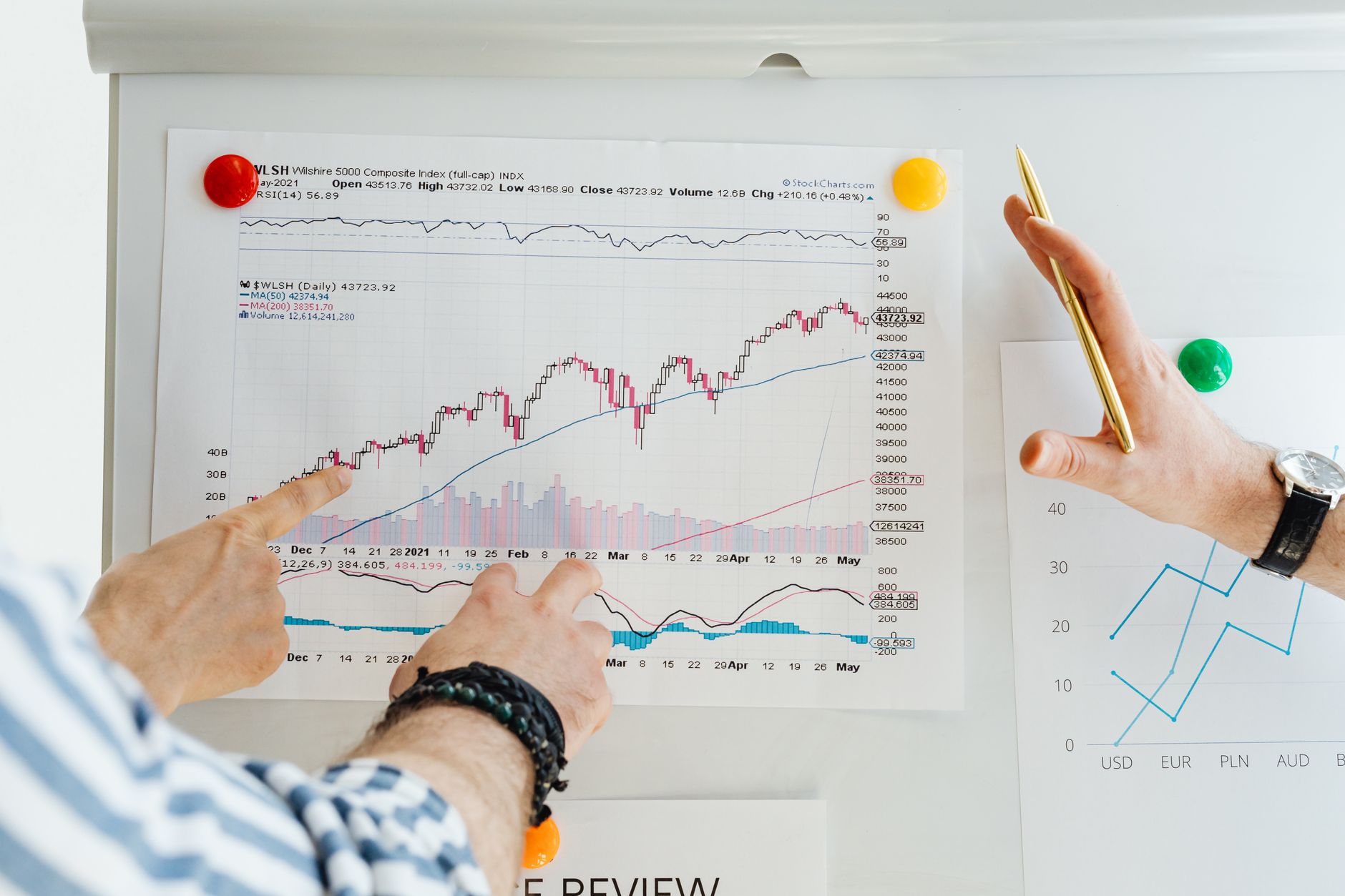
Key takeaways
- A stock market index is just a scoreboard. It tracks a chosen basket of companies so one number can stand in for the whole group, and you cannot buy the index itself.
- The S&P 500 is the real benchmark for U.S. stocks. It holds about 500 large companies, weights them by size, and captures roughly 80 percent of the total value of the U.S. stock market.
- The Dow is famous and quirky. It tracks only 30 companies and weights them by share price instead of company size, which makes a high-priced stock count more than a giant one.
- The Nasdaq Composite and Nasdaq-100 lean heavily toward technology, while the Russell 2000 tracks small companies, so they each tell a different part of the story.
- Market-cap weighting and price weighting are simple arithmetic, and the math explains almost every weird thing the indexes do.
- You invest in an index by buying a low-cost index fund or ETF that copies it, which is the single most practical takeaway in this entire guide.
Turn on any business channel and within thirty seconds someone will tell you the market was up half a percent, the Dow fell 200 points, or the Nasdaq is having a rough week. These numbers get repeated like weather, as if everyone already knows what they mean. Most people do not, and that is completely reasonable, because nobody ever explains them. An index is one of the most useful ideas in investing once you see how it works, and one of the most confusing while it stays a mystery. This guide walks through every index you hear quoted, the surprisingly simple math underneath them, and the one practical move that turns all of this theory into something you can actually own.
What an Index Actually Is and Why It Exists
A stock market index is a scoreboard. It takes a chosen list of companies, applies a formula to combine their prices into a single number, and tracks how that number changes over time. That is the whole concept. The index does not hold any money, does not buy or sell anything, and cannot be purchased. It is a measurement, the way a thermometer reading is a measurement and not the temperature itself.
Indexes exist because the U.S. stock market contains thousands of companies, and no human can watch all of them at once. Before indexes, saying how stocks did on a given day was nearly impossible. You would have to look at every company individually and somehow average the chaos in your head. An index solves that by deciding in advance which companies count, and exactly how to weigh them, so one number can fairly represent the group. When that number rises, the basket got more valuable. When it falls, it lost value. Simple to read, once you know what is inside.
The catch that trips up almost everyone is right here. Because an index is only a calculation, you can never buy it directly. There are no shares of the S&P 500 sitting on a shelf. What you can buy is a fund built to copy the index, and we will get to exactly how that works. First, meet the indexes themselves.
The S&P 500: The One That Actually Matters
If you only learn one index, learn this one. The S&P 500 tracks about 500 of the largest U.S. companies, and it is the benchmark that serious investors, fund managers, and economists actually use when they talk about how American stocks are doing. When a financial professional says the market, they almost always mean the S&P 500.
Two things make it the gold standard. First, breadth. Five hundred companies across every major industry is enough to represent the whole economy rather than one slice of it. Second, and more important, it is weighted by market capitalization, which means each company counts in proportion to its total size. A company worth three trillion dollars moves the index far more than a company worth thirty billion, which is exactly how it should be, because the big company represents far more of the actual market.
Here is the number that surprises people. Those roughly 500 companies capture close to 80 percent of the total value of the entire U.S. stock market. There are thousands of other public companies, but they are mostly small, and together they make up only the remaining sliver. So when you track the S&P 500, you are tracking the overwhelming majority of U.S. stock value with a single number. That efficiency is why it became the default.
One consequence of market-cap weighting is worth sitting with. Because the biggest companies count the most, a handful of giant technology firms can drive the index on their own. On some days the S&P 500 rises while most of its 500 companies fall, simply because the few largest ones rose enough to outweigh everyone else. The index is a weighted average, not a vote, and that distinction explains a lot of confusing headlines.
The Dow Jones Industrial Average: Famous and Genuinely Quirky
The Dow is the oldest and most famous market number in America, born in 1896, and it is also the strangest one still in daily use. Two features make it odd. It tracks only 30 companies, not 500. And it weights them by share price rather than by company size, which is a genuinely backwards way to measure a market.
Price weighting means a stock with a higher share price has more influence on the Dow, regardless of how big the company actually is. This leads to results that make no economic sense. Imagine a small company whose shares trade at $500 and a giant company whose shares trade at $50. In the Dow, the small expensive-share company has ten times the influence of the giant, even though the giant might be worth twenty times more in total. Share price is mostly an accident of how many shares a company chose to issue, so weighting by it is a bit like ranking cars by the size of their license plates.
For this reason, almost no professional uses the Dow as a serious benchmark. It survives because it is famous, not because it is good. When you hear the Dow fell 300 points, remember that a point on the Dow is not a percentage and not a dollar of market value. It is a quirk of a 30-stock, price-weighted formula that happens to have a very long history. The table below lines up the major indexes so you can compare them directly.
The Nasdaq: Composite Versus the 100
People say the Nasdaq as if it were one thing, but there are two different Nasdaq indexes, and the difference matters. Both are heavily weighted toward technology companies, which is why the Nasdaq is treated as a proxy for how tech is doing.
The Nasdaq Composite includes essentially every company listed on the Nasdaq stock exchange, which is several thousand of them. It is broad, but because so many large technology firms list on the Nasdaq, it tilts hard toward tech and is far more volatile than the S&P 500. When technology booms, the Nasdaq Composite often outruns everything. When tech stumbles, it falls harder too.
The Nasdaq-100 is the more curated cousin. It holds the 100 largest non-financial companies listed on the Nasdaq, and it is the version most tech-focused index funds and ETFs actually track. If you have heard of a popular ETF that follows the Nasdaq, it almost certainly tracks the Nasdaq-100, not the full Composite. Think of the Composite as the wide-angle tech photo and the Nasdaq-100 as the zoomed-in shot of the biggest names.
The Russell 2000: Where the Small Companies Live
The big three indexes all lean toward large companies, which leaves a gap. The Russell 2000 fills it. It tracks about 2,000 small companies, the kind that are too small to appear in the S&P 500, and it is the most widely watched measure of how small-cap U.S. stocks are doing.
Small companies behave differently from large ones. They tend to be more sensitive to the domestic economy, more volatile, and more closely tied to interest rates and lending conditions. Because of this, investors often watch the Russell 2000 as a read on the health of smaller, more local businesses, separate from the giant multinationals that dominate the S&P 500. When the Russell and the S&P 500 move in different directions, it usually says something about which part of the economy is doing the heavy lifting.
Total-Market and International Indexes
If 500 large companies capture 80 percent of U.S. value, what about the other 20 percent? That is where total-market indexes come in. A total U.S. stock market index aims to include nearly every public U.S. company, large and small, in one basket. In practice, because it is still market-cap weighted, a total-market index behaves very similarly to the S&P 500 day to day. The giant companies dominate both. The total-market version simply folds in the small and mid-sized companies for completeness, which is why many long-term investors treat an S&P 500 fund and a total-market fund as nearly interchangeable cores.
International indexes are the bigger leap, and the more meaningful diversifier. The U.S. indexes, by definition, contain only U.S. companies. That leaves out enormous businesses headquartered in Europe, Japan, and emerging markets. International indexes track those companies, and adding one to a portfolio is how investors avoid betting their entire future on a single country's stock market. The U.S. has been a strong performer for a long stretch, but no country leads forever, and international exposure is the standard way to hedge that uncertainty.
The Math: Market-Cap Weighting Versus Price Weighting
Almost every strange thing an index does comes from how it weights its members, so it is worth doing the arithmetic once, slowly, with small numbers. The two systems are market-cap weighting, used by the S&P 500, and price weighting, used by the Dow.
Market capitalization is simply a company's share price multiplied by its number of shares. It is the total dollar value of the whole company. In a market-cap-weighted index, each company's influence equals its share of the combined market cap of every member. Imagine a tiny three-company index. Company A is worth $600 billion, Company B is worth $300 billion, and Company C is worth $100 billion. The total is $1,000 billion. Company A therefore controls 60 percent of the index, Company B controls 30 percent, and Company C controls 10 percent. If Company A rises 10 percent and the others hold still, the index rises 6 percent, because A's gain is weighted by its 60 percent share. This is sensible. The biggest company has the biggest effect, exactly matching its real importance.
Price weighting throws all of that out and looks only at share price. In a price-weighted index, you essentially add up the share prices and influence is proportional to each price. Now imagine three companies again, but this time look only at their share prices. Company A's shares trade at $50, Company B's at $100, and Company C's at $300. The total of the prices is $450. Company C controls 300 divided by 450, or about 67 percent of the index, purely because its shares carry a high sticker price. Its actual size as a business does not enter the calculation at all.
Here is the punchline. A company can make its shares cheaper overnight through a stock split, doubling its share count and halving its price, without changing its real value one cent. In a market-cap index, that split changes nothing, because total value is unchanged. In a price-weighted index like the Dow, that same split slashes the company's influence in half. The visual below works through both systems side by side so you can see how the same three companies produce completely different index behavior.
How You Actually Invest in an Index
Now the practical part, the reason any of this matters for your money. You cannot buy an index. You buy a fund that copies one. There are two common forms, and they are more alike than different.
An index mutual fund is a pooled investment that holds all the stocks in an index, in the same proportions, and aims to match the index's return. You buy it directly from a fund company, and it prices once per day after the market closes. An index ETF, or exchange-traded fund, does the same job but trades on the stock exchange like a stock, so you can buy or sell it any time the market is open, at a live price. For a long-term investor making steady contributions, the practical difference between the two is small. Both give you the same basket.
The feature that makes index funds revolutionary is cost. Because the fund just copies a published list rather than paying analysts to pick stocks, it is cheap to run. Many broad index funds and ETFs charge expense ratios near or below 0.05 percent per year. On a $10,000 investment, that is about five dollars annually. Compare that to an actively managed fund charging 0.75 percent, or seventy-five dollars on the same balance, and you can see why low-cost index funds reshaped investing. The steps below show how owning an index actually works, start to finish.
What "The Market Was Up 1 Percent" Really Means
Return to that phrase from the news, because you can now decode it. When a reporter says the market was up 1 percent, they almost always mean the S&P 500 closed 1 percent higher than the day before. They rarely mean every stock rose 1 percent, and they certainly do not mean most stocks rose at all.
Because the S&P 500 is market-cap weighted, that 1 percent is a weighted average dominated by the largest companies. If the few biggest firms have a strong day, the index can rise even while a majority of its 500 members fall. The headline number is true, but it is not a headcount of winners and losers. It is a value-weighted summary, and on any given day the experience of the average stock can differ sharply from the experience of the index.
This is also why your own portfolio can diverge from the headline. If you own different companies, or own them in different proportions, your day will not match the S&P 500's day. The index describes a specific basket weighted a specific way. It is a useful summary of the overall market's value, not a promise about any individual stock or any individual investor.
A Live Look at the S&P 500
Numbers on a page only go so far, so here is the actual S&P 500 over the past year, updating on its own. Notice the shape rather than any single point. The line climbs and dips, sometimes sharply, and that ordinary volatility is exactly what a long-term index investor learns to sit through. The index does not move in a straight line, and it was never supposed to.
Watching the line wiggle is also a quiet lesson in why short-term moves matter so little. A long-term investor who buys an index fund and keeps contributing is not trying to catch the bumps. They are betting on the broad upward drift of the whole market over years and decades, and letting the daily noise wash out. The chart above will keep updating long after you read this, and most of its day-to-day motion will turn out, in hindsight, to have been noise.
Index Funds: The Practical Takeaway
Strip away the names and the math, and this entire topic collapses into one usable idea. The indexes are scoreboards. The S&P 500 is the scoreboard that matters most for U.S. stocks. And the way an ordinary person participates is by buying a low-cost index fund or ETF that tracks a broad index, then contributing to it steadily over a long time.
That is why index funds get recommended so relentlessly. They are cheap, because copying a list is cheap. They are diversified, because a single S&P 500 fund spreads your money across about 500 companies in one purchase. And they are simple, because you do not have to pick winners. You own the whole scoreboard. For a great many long-term savers, a broad index fund or a small combination of them, perhaps a U.S. fund paired with an international one, is the entire investing plan, not the starting point for something more complicated.
None of this is personalized advice, and the right mix depends on your own situation, timeline, and risk tolerance. But understanding what the indexes are, and that you reach them through funds rather than buying them directly, removes most of the mystery that keeps people on the sidelines. The next time the news says the market was up 1 percent, you will know exactly which basket moved, why the big companies counted most, and how an ordinary person would have owned a slice of all of it for about five dollars a year.
Most investors cannot pass a basic money test. Can you?
The market charges tuition for every gap in your knowledge. The Financial IQ Test measures what you actually know across investing, banking, credit, and retirement, then shows you exactly which gaps to close before they get expensive.
Test your Financial IQQuestions people ask
Can I buy the S&P 500 directly?
No. An index is just a calculation, a list of companies and a formula, so there is nothing to actually purchase. What you buy is an index fund or an ETF that holds the same companies in the same proportions and aims to match the index's return. Dozens of these exist, many with expense ratios near or below 0.05 percent, meaning a few dollars a year per $10,000 invested.
Why does the Dow get quoted if the S&P 500 is better?
Mostly history and habit. The Dow Jones Industrial Average launched in 1896 and was the original daily market headline number, so it stuck in the culture long before the S&P 500 existed. Professionals and index funds overwhelmingly use the S&P 500 or total-market indexes because they are broader and weighted more sensibly. The Dow survives as a familiar shorthand, not as a serious measuring stick.
What is the difference between the Nasdaq Composite and the Nasdaq-100?
The Nasdaq Composite includes essentially every company listed on the Nasdaq exchange, which is several thousand stocks. The Nasdaq-100 is a curated subset of the 100 largest non-financial companies on that exchange. Both lean heavily toward technology, but the Nasdaq-100 is the one most tech-focused index funds and ETFs actually track.
When the news says the market was up 1 percent, which market is that?
Almost always the S&P 500, sometimes the Dow. Because both are weighted toward their biggest members, a 1 percent move often means the largest companies moved, not that every stock rose evenly. On any given up day, a meaningful share of individual stocks can still fall. The index number is a weighted average, not a headcount.
Is an index fund the same thing as an index?
No, and the distinction matters. The index is the scoreboard, a list and a formula maintained by a company like S&P Dow Jones Indices. The index fund is an actual investment product, run by a firm like Vanguard or Fidelity, that buys the underlying stocks to track that scoreboard. You own shares of the fund, and the fund owns the stocks.
Should I pick the S&P 500, a total-market fund, or something international?
Many long-term investors hold a total U.S. market fund or an S&P 500 fund as a core, then add an international fund for broader diversification. The S&P 500 already covers most U.S. value, so the practical gap between it and a total-market fund is small. International exposure is the more meaningful diversifier because it adds companies the U.S. indexes leave out entirely. This is education, not personalized advice.
Keep reading

How to Choose a Brokerage Account in 2026: A Practical Guide
Dividend Investing for Beginners: Income You Can Actually See

Dollar-Cost Averaging: The Math, the Myths, and When It Wins
The Flourish Letter
One smart money idea each week, charts included. Join free and get the printable 2026 Money Calendar in your welcome email.