Key takeaways
- Buy crypto only with money you can afford to lose entirely, and only after high-interest debt is gone and an emergency fund is parked somewhere boring and insured.
- On an exchange, the company holds your coins and you hold an IOU; in your own wallet, you hold the coins and all of the responsibility.
- Crypto transfers are final, so a wrong address, a phished password, or a leaked seed phrase usually means the money is gone with no fraud department to call.
- A short security checklist, unique password, app-based two-factor authentication, a test transaction, and an offline seed phrase, prevents the large majority of beginner losses.
- Anyone who contacts you first with a crypto opportunity, guarantees returns, or asks you to pay a fee to withdraw your own money is running a script, not an investment.
Buying crypto in 2026 takes about four minutes. Buying it safely takes about an hour of setup, a handful of habits, and a clear-eyed understanding of one fact that separates this from every other account you own: in crypto, most mistakes are permanent. There is no fraud department, no chargeback, no password-reset email that saves you. The good news is that the people who lose money to hacks and scams almost always skip the same short list of precautions, which means you can put yourself in the safer group in a single afternoon. This guide walks the whole path: deciding whether to buy at all, choosing where, executing the purchase, locking it down, and recognizing the scripts scammers will inevitably run at you. No hype and no shortcuts, because shortcuts are exactly what the bad guys are counting on.
The reality check before you buy anything
Safety starts before the account does. Crypto is a speculative asset that has repeatedly lost half or more of its value in a year; bitcoin itself fell roughly 77 percent from late 2021 to late 2022, and most smaller tokens fell harder and never came back. So the first safety rule has nothing to do with passwords: only buy with money whose total loss you could absorb without changing your life.
A simple readiness test many planners use: high-interest debt is paid off, because no asset reliably beats a 24 percent credit card APR. Three to six months of expenses sit in an emergency fund somewhere insured and dull, like a high-yield savings account. Retirement contributions are on track. If all three boxes are checked, a small speculative allocation, commonly a low single-digit percentage of investable assets, is a choice an adult can defend. If they are not, the safest crypto purchase is the one you postpone.
One more piece of mental furniture: nothing in crypto is FDIC insured. Deposit insurance covers bank deposits. It does not cover coins on an exchange, tokens in a wallet, or anything a crypto platform markets with comforting bank-like language.
Exchange vs. wallet: the custody question everything hangs on
Every safety decision in crypto flows from one question: who holds the keys?
When you buy on an exchange, the exchange holds the coins in its own wallets and credits your account, the way a bank credits your checking balance. You hold an IOU. This is convenient, and at a large, US-regulated, publicly accountable exchange it is a reasonable place for small amounts. But it concentrates risk in one company's security and solvency. The collapse of FTX in November 2022 is the permanent case study: one of the world's largest exchanges turned out to be quietly using customer funds, and millions of users learned that an account balance on a screen is a legal claim in a bankruptcy, not money in hand. Celsius, BlockFi, and Voyager taught the same lesson the same year.
When you withdraw coins to a wallet you control, the picture inverts. A wallet is just software, or a small hardware device, that holds your private keys. No company can freeze, lend, or lose your coins, because no company has them. The cost is that every safety net disappears with the middleman: lose the keys, lose the money; leak the keys, lose the money. Crypto people compress this into a slogan, not your keys, not your coins, and the slogan is accurate in both directions. Your keys, your coins, and entirely your problem.
There is no universally right answer, but there is a sensible progression: start tiny on a major exchange, learn to move coins with test amounts, and graduate balances to self-custody, or to a spot ETF if you would rather hold exposure inside a brokerage, as the dollars grow up.
Choosing an exchange in 2026
The field has consolidated since the 2022 washouts, and the screening criteria are not secret. A reasonable US buyer in 2026 looks for, at minimum: a US-based and US-regulated operation that is registered with FinCEN and licensed in your state, with identity verification at signup, which is a feature, not an intrusion, since it signals the platform operates inside the law. A long public operating history and public accountability, ideally a publicly traded parent or audited financials. Mainstream security architecture: the bulk of customer assets held in cold storage, mandatory two-factor authentication, and withdrawal allowlisting. Clear, posted fees, because confusing pricing is its own red flag. And no aggressive yield offers on deposits; platforms that promised double-digit returns on parked crypto were, again and again, taking risks their customers discovered only in bankruptcy filings.
Two cautions even with good exchanges. Proof-of-reserves reports, which became fashionable after FTX, are better than nothing but are snapshots, not full audits, and they say little about liabilities. And customer-support impersonation is rampant: bookmark your exchange's real site, log in only from your own bookmark or official app, and treat every inbound call, text, or email claiming to be the exchange as hostile until proven otherwise. Real exchanges essentially never call you.
The buying process, start to finish
Here is the full path from dollars in your bank account to crypto under your own keys. Steps one through four cover everyone; five through seven apply when you decide to self-custody.
A few notes the infographic compresses. On funding: bank transfers (ACH) are usually free or cheap but settle in days; debit card purchases are instant and expensive, often 2 to 4 percent. There is rarely a reason to pay card fees for a long-term purchase. Never buy crypto with a credit card; many issuers block it, the cash-advance fees are punitive, and borrowing at card rates to speculate is how bad months become bad years.
On order types: a simple market order is fine for small amounts in liquid assets like bitcoin. The more useful discipline for beginners is the recurring buy, a fixed dollar amount weekly or monthly, which removes timing decisions, smooths your entry price, and caps the speed at which you take on risk while you are still learning.
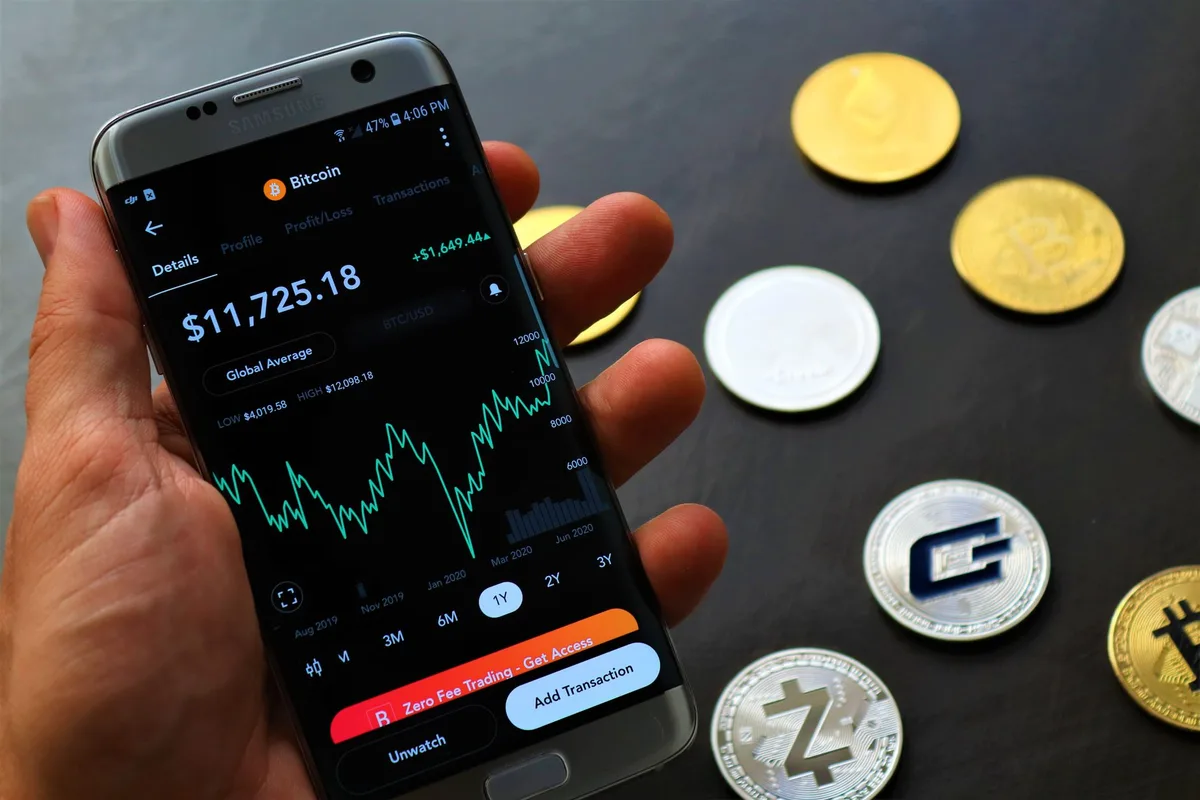
And on what you are buying: know its temperament before you own it. This is bitcoin's actual trading week, live, not a brochure:
If a week like that one, or one three times wilder, would send you into panic-selling, the position is too large or the asset is not for you. Decide that now, calmly, rather than later, expensively.
Self-custody without tears: hardware wallets and seed phrases
If you choose to hold your own keys, the gold standard for meaningful amounts is a hardware wallet: a small device, typically $60 to $200 from a reputable hardware wallet maker, that keeps your keys offline and physically confirms every transaction on its own screen. Malware on your computer cannot spend what it cannot reach. Buy the device only from the manufacturer directly, never from online marketplace resellers, where tampered units with pre-known seed phrases have been documented.
When you set the device up, it shows you a seed phrase: 12 or 24 plain words that can regenerate your entire wallet on any compatible device. Understand exactly what this is: the words are the money. Anyone who copies them can take everything from anywhere on earth, and anyone who loses them, with the device broken or missing, has lost everything with no recourse.
The handling rules are strict because the failure mode is total. Write the phrase on paper or stamp it into a steel backup plate; never photograph it, never type it into a computer or phone, never store it in email, notes apps, cloud drives, or a password manager. Keep it somewhere that survives fire and theft, such as a home safe or a bank safe deposit box, and consider a second copy in a second location. And burn this into memory: no legitimate wallet company, exchange, support agent, or app update will ever ask for your seed phrase. One hundred percent of seed phrase requests are theft attempts. There are no exceptions, which makes this the easiest scam detector you will ever own.
Before moving real money, run the drill: send a small test amount from the exchange to your wallet, confirm it arrives, then send a little back. Address-checking habits matter here too. Always paste rather than type, then verify the first and last several characters on the wallet's own screen, because clipboard-hijacking malware that silently swaps addresses is a real and common attack.
The security checklist
Most crypto losses by ordinary people are not exotic hacks. They are reused passwords, text-message-based two-factor codes stolen via SIM swaps, phishing links from search ads, and seed phrases typed into fake websites. This checklist closes those doors, and almost nothing on it costs money.
The two items worth underlining: use an authenticator app or a hardware security key for two-factor authentication, never text messages, because SIM-swap attacks, where a criminal takes over your phone number at the carrier level, defeat SMS codes entirely while you watch your phone go dark. And reach your exchange only through your own bookmark, because scammers buy search ads impersonating exchange login pages, and the fakes are pixel-perfect.
The red flags, translated
Crypto scams did not get clever; they got industrialized. The scripts are stable enough that you can learn them like a phrasebook. Reported losses keep climbing, and the FBI's Internet Crime Complaint Center tallied on the order of $9 billion in crypto-related fraud losses for 2024 alone, with people over 60 hit hardest.
Here is the phrasebook. When you hear the line on the left, your brain should silently translate it to the line on the right.
The universal pattern under all of these: legitimate finance never contacts you first with an opportunity, never guarantees returns, never demands urgency, and never requires payment in crypto or gift cards to release your own money. The moment a withdrawal requires paying a tax or fee upfront, you are not withdrawing; you are being farmed for one final payment. Stop, take screenshots, and report it at ic3.gov and reportfraud.ftc.gov.
Taxes and records: the unglamorous part that saves you later
One more safety habit, this time against an entirely legal adversary: your own future tax return. The IRS treats crypto as property, so selling it, trading one coin for another, or spending it are all taxable events. And as of the 2025 tax year, US exchanges report customer sale proceeds to the IRS on the new Form 1099-DA, so the agency increasingly sees your activity whether or not you report it.
From your very first purchase, keep records: date, asset, amount, dollar cost, and fees, for every buy, sell, trade, and transfer. Exchanges provide history exports, but exchanges also go out of business, so download your own copies once a year. Five minutes of record-keeping per month spares you a genuinely miserable reconstruction project, or an expensive one, at tax time. If you do nothing else, never let activity sprawl across many platforms you barely remember; sprawl is how people end up guessing on a federal form.
Putting it all together
The safe path, condensed: buy only what you can afford to lose, after the financial foundations are poured. Use a large, US-regulated exchange or a spot ETF, funded by bank transfer, ideally as a small recurring buy. Lock the account with a unique password and app-based two-factor authentication, and reach it only through your own bookmark. When balances grow meaningful, move them to a hardware wallet bought direct from the maker, with the seed phrase on paper or steel, offline, forever. Test with small amounts before every meaningful transfer. Translate every unsolicited opportunity as a scam, because statistically it is. Keep records like an adult.
None of this is exciting, which is exactly the point. In crypto, excitement is what the other side of the trade is hoping you bring. Bring a checklist instead.
Crypto punishes guesswork faster than any market on Earth.
Volatility is survivable. Not knowing what you own is not. The Financial IQ Test measures your actual money knowledge, from market basics to risk math, so your conviction is built on understanding instead of a feed full of hype.
Test your Financial IQQuestions people ask
How much money do I need to start?
Almost nothing. Major exchanges let you buy $5 or $10 worth, and spot ETF shares can be bought fractionally at many brokerages. Starting tiny is actually the safest way to learn the mechanics, because your tuition for any mistake is the price of lunch instead of a paycheck.
Should I just leave my crypto on the exchange?
For small amounts at a large US-regulated exchange, many people do, and the convenience is real. But an exchange balance is a claim on a company, not coins in your hand, and customers of failed platforms like FTX and Celsius waited years in bankruptcy court to recover only part of their money. A common rule of thumb: once the balance would genuinely hurt to lose, learn self-custody or use a spot ETF instead.
What exactly is a seed phrase?
It is a list of 12 or 24 ordinary words that mathematically generates every key in your wallet. Anyone who has the words has the money, from anywhere on earth, instantly. That is why it should be written on paper or stamped in metal and stored offline, and why no legitimate company, support agent, or app will ever ask you to type it in. Every request for your seed phrase is a theft attempt, without exception.
Can I buy crypto inside my IRA or 401(k)?
You can get bitcoin and ether price exposure in most brokerage IRAs through spot ETFs, which US regulators approved starting in 2024. That route keeps everything inside familiar account protections and consolidated tax reporting. Buying coins directly inside retirement accounts is possible through specialty custodians but adds fees and complexity most savers do not need.
What happens if I send crypto to the wrong address?
In almost every case it is gone. There is no payment reversal system, and the recipient address may belong to no one at all. This is why careful people copy and paste addresses rather than typing them, verify the first and last several characters after pasting, and send a small test amount first whenever the transfer is meaningful.
Is it safer to buy a spot ETF instead of actual crypto?
It removes a specific set of risks: no exchange account to hack, no seed phrase to lose, no withdrawal mechanics to fumble. The price risk, which is the biggest risk, is completely unchanged, and you can never withdraw actual coins. For someone who only wants exposure and zero new responsibilities, the ETF is the simpler instrument.
Keep reading
Bitcoin Explained for Normal People (2026 Edition)
The Crypto Scam Field Guide: Every Major Con and How to Spot It
Crypto Taxes in 2026: What You Actually Owe the IRS
The Flourish Letter
One smart money idea each week, charts included. Join free and get the printable 2026 Money Calendar in your welcome email.