Key takeaways
- Bitcoin hash rate is the estimated total number of hash guesses the network makes each second, a measure of computational power devoted to securing blocks.
- Higher hash rate generally raises the cost of attacking the network, which is why security conversations start with this number rather than with price charts.
- About every two weeks, or every 2,016 blocks, Bitcoin adjusts mining difficulty so that blocks keep arriving near a 10-minute average even when hash rate rises or falls.
- Energy use scales with mining hardware running flat out; researchers track that footprint with tools such as the Cambridge Bitcoin Electricity Consumption Index, and the debate is real without needing a partisan script.
- Hash rate is not price and not market cap; rising hash rate can coexist with falling prices, and treating it as a buy or sell signal is a common misuse.
- For everyday investors, hash rate is useful context about network security and miner economics, not a forecast tool and not a substitute for understanding volatility and loss risk.
Scroll crypto Twitter for an hour and you will meet the same chart twice: bitcoin's price, and something labeled hash rate that looks like a stairway to the moon. Commentators treat the second chart like a secret weather report for the first. When hash rate rises, bulls cheer that the network is "stronger than ever." When hash rate dips, bears warn that miners are "capitulating" and that price must follow. Both stories can feel persuasive. Both often oversell what the number actually means. Hash rate is one of the most important security statistics on Bitcoin, and one of the most abused as a price signal. This guide explains what hash rate measures in plain English, why it matters for network security, how it couples to the roughly two-week difficulty adjustment, how energy enters the conversation without a political rant, and why hash rate is not the same thing as price or market cap. The goal is literacy, not a trade.
What hash rate actually measures
Bitcoin miners compete to add the next block by repeatedly running a cryptographic hash function over candidate block headers. A hash function scrambles input into a fixed-length fingerprint. Change one bit of the input and the fingerprint changes in a way that looks random. There is no clever formula that tells you which input will produce a fingerprint small enough to meet the network's target. Miners try again and again, as fast as their machines allow.
Hash rate is the estimated rate of those tries across the whole network, usually expressed as hashes per second. One hash per second means one guess per second. Modern network totals are so large that people speak in terahashes (trillions of hashes per second) and exahashes (quintillions of hashes per second). You will see abbreviations like TH/s and EH/s on dashboards. The unit is speed of guessing work, not dollars, not coins, and not "how many people believe in Bitcoin."
Nobody has a perfect census of every mining chip on earth. Public hash rate figures are estimates inferred from how quickly blocks are found relative to the current difficulty. If blocks arrive faster than expected, observers infer that more hashing power is online. If blocks arrive slower, they infer that hashing power has dropped or is temporarily offline. The estimate is good enough for macro conversation and imperfect at the edges, especially around sudden weather events, power curtailments, or large miners switching pools.
Think of hash rate the way you might think of total engine horsepower in a shipping fleet. More horsepower does not tell you the freight rate for tomorrow. It does tell you something about capacity and about how expensive it would be for a rival fleet to outmuscle the incumbents.
Why hash rate matters for security
Bitcoin's proof-of-work design makes rewriting recent history expensive. To replace a stretch of blocks, an attacker needs to outpace the honest network's hashing work and produce an alternate chain that other nodes accept as longer or heavier under the protocol's rules. In everyday language, that means an attacker needs a huge share of global hash rate, often discussed under the shorthand of a 51 percent attack, and needs to sustain that work while paying for hardware, electricity, and opportunity cost.
All else equal, a higher honest hash rate raises the resource bill for that kind of attack. That is the clean security claim, and it is the reason network operators, researchers, and careful investors watch the figure. It is not a guarantee that attacks are impossible. It is a statement about economic friction. Security here is purchased continuously with energy and silicon, not granted once by a marketing slogan.
Hash rate is also unevenly distributed in practice. Much of the work flows through mining pools that coordinate many machines and then split rewards. Pool concentration is a different security conversation from raw global hash rate. A network can have enormous total hash rate and still raise questions if a small number of pool operators temporarily direct a large share of that power. The headline EH/s number does not by itself prove perfect decentralization. It proves that a large amount of specialized work is being done.
For a reader who never plans to mine, the security takeaway is still useful. When people say Bitcoin is hard to censor or reverse at the base layer, they are pointing at this costly race. Confirmations pile up because more work piles on top of your transaction's block. Hash rate is the fuel gauge for that race.
Difficulty adjustment: the roughly two-week feedback loop
If hash rate were the only moving part, block times would swing wildly. Flood the network with new machines and blocks would arrive in a rush. Switch half the machines off and the chain would crawl. Bitcoin solves that with an automatic difficulty adjustment described in the project's developer documentation.
The network targets an average of about one new block every 10 minutes. Every 2,016 blocks, software looks at how long that window actually took using timestamps in the block headers. The ideal span is 1,209,600 seconds, which is two weeks. If the blocks arrived faster than that, difficulty rises so the next window should slow back toward the target if hashing power stays similar. If the blocks arrived slower, difficulty falls. The protocol limits how far a single adjustment can swing, which keeps the feedback from becoming chaotic.
This is why hash rate and difficulty are partners, not synonyms. Hash rate is the observed work rate. Difficulty is the hardness setting the rules enforce. When hash rate climbs and stays elevated, difficulty ratchets up over successive adjustment periods until the 10-minute pace returns. When hash rate crashes, difficulty eases, which can help remaining miners stay online because valid blocks become relatively easier to find at the same machine speed.
A practical implication for newcomers: a short burst of fast blocks after a price spike does not mean Bitcoin "broke." It usually means hash rate rose faster than the last difficulty setting expected, and the next adjustment is the intended correction. Likewise, slow blocks after a miner exodus are a signal the adjustment will likely ease, not a sign that the ledger stopped working.
Hash rate, miner revenue, and why machines turn on or off
Miners are businesses, even when the machines sit in a converted warehouse. Revenue comes mainly from the block subsidy of newly created bitcoin plus transaction fees in the blocks they win. Costs include electricity, hardware purchase and depreciation, cooling, rent, staffing, pool fees, and financing. When bitcoin's price rises or fees spike, more marginal machines can cover their power bills. When price falls hard or power prices spike, the least efficient machines shut down first.
That economics chain is why hash rate often responds to price with a lag. Machines take time to ship, install, and energize. Hosting contracts and curtailment agreements matter. Some miners hedge power or coin exposure. So a green candle on a price chart does not summon exahashes overnight, and a red month does not instantly delete every ASIC from the planet. Hash rate can keep grinding higher through a painful bear market if newer, more efficient hardware arrives and older gear is retired, because efficiency changes the break-even math.
When commentators say "miners are capitulating," they sometimes mean that hash rate is falling as unprofitable machines power down. That can be true in sharp stress periods. It can also be overstated noise around maintenance, weather, or seasonal power markets. A single down day in an estimated hash rate chart is a weak foundation for a bold market call.
Energy at a high level, without the partisan script
Because proof-of-work converts electricity into security, energy use is inseparable from hash rate. More machines hashing usually means more power draw, unless efficiency gains outrun the growth in total work. Specialized ASIC miners are far more efficient per hash than the CPUs and GPUs of Bitcoin's early years, yet the absolute scale of the network is now large enough that annual electricity estimates land in the same conversation as midsize countries.
The Cambridge Bitcoin Electricity Consumption Index is one widely cited research effort that publishes modeled estimates and methodology rather than a single dramatic slogan. U.S. energy authorities have also paid attention to large crypto mining loads on the grid. Those sources exist so citizens and investors can look at magnitudes instead of vibes.
Two honest frames sit side by side. One frame says the energy is the cost of a monetary network that does not rely on a central operator, and that miners often chase the cheapest available power, including flexible or stranded supply. Another frame says any large always-on load deserves scrutiny for carbon intensity, local grid stress, and opportunity cost relative to other uses of electricity. You do not need to join a team to hold both ideas at once. Hash rate growth makes the energy question louder because it scales the work. Efficiency improvements and fuel mix changes can soften or sharpen the impact depending on where and how miners operate. The debate is about tradeoffs, not about whether hashes somehow run on wishful thinking.
How investors misuse hash rate as a price signal
Here is where retail education matters most. Hash rate charts are easy to screenshot and easy to mythologize. Common misreads include:
- "Hash rate all-time high means price all-time high is next." Security work and speculative price are coupled through miner economics, not locked in a fixed ratio. Long stretches of rising hash rate have coincided with rising prices, falling prices, and sideways grind. Correlation in one cycle is not a law of nature.
- "Falling hash rate means Bitcoin is dying." Difficulty adjusts. Miners exit and re-enter. The protocol is built for variable participation. A drawdown in hash rate can signal miner stress without implying that nodes stop validating or that coins vanish.
- "Buy when hash rate dips because survivors are stronger." This is a story about industry Darwinism dressed up as a timing tool. Even if survivor hardware is more efficient later, your entry price and your time horizon still dominate outcomes. Crypto drawdowns can exceed what "strong hands" rhetoric prepares people for.
- "Hash ribbons" or similar overlays as certainty machines. Some traders blend moving averages of hash rate into buy signals. As education, it is fine to know the idea exists. As a household money plan, treating any single miner metric as a green light ignores liquidity needs, taxes, scams, and the basic SEC caution that crypto markets are speculative and volatile.
A cleaner habit is to ask what question you are answering. If the question is "Is a lot of specialized work still securing the chain?" hash rate helps. If the question is "Will next month's price be higher?" hash rate is a weak oracle. Price is set at the margin by buyers and sellers of coins and coin-linked products, including people who never look at a mining dashboard.
Hash rate vs price vs market cap
These three numbers get mashed together in casual talk. Separating them prevents expensive confusion.
Hash rate estimates how fast the network is performing proof-of-work guesses. Unit: hashes per second (often EH/s). Driver: mining hardware online and running. Main use: security and miner industry health.
Price is what someone is willing to pay for one bitcoin (or a claim on bitcoin) in a given market at a given moment. Unit: USD per BTC on the venues you watch. Driver: order flow, liquidity, macro risk appetite, news, leverage, and countless other forces. Main use: marking positions and planning cash needs.
Market capitalization is a rough valuation snapshot, typically price multiplied by circulating supply. Unit: USD. Driver: price first, with supply changing slowly under Bitcoin's issuance schedule. Main use: size comparisons with other assets, with the usual caveats that crypto market-cap figures can be messy around liquidity and lost coins.
A simple arithmetic reminder keeps the categories honest. Suppose circulating supply is about 19.8 million BTC and the price prints at $60,000. Rough market cap is 19.8 million times $60,000, which is about $1.19 trillion. That calculation did not consult hash rate at all. Separately, the network might be estimating hundreds of EH/s of hashing. That security statistic did not appear in the market-cap product. If price fell to $45,000 while hash rate held steady, market cap would drop by about 25 percent in this sketch while security work stayed large. If hash rate later fell 10 percent while price recovered, you would again see the series move for different reasons. Mixing the charts into one narrative is how people talk themselves into false confidence.
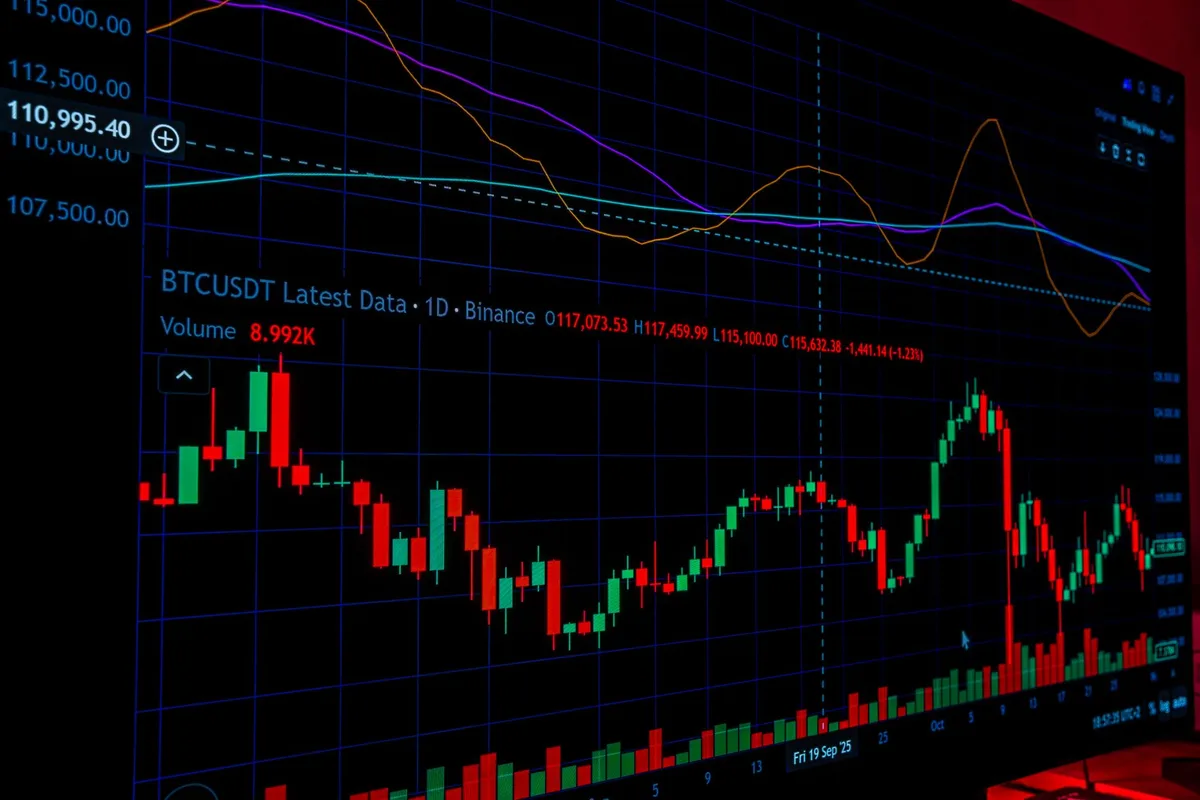
Live price is what most households feel day to day. Here is a current window on bitcoin's USD price path. Notice that this visual is price, not hash rate. Keeping the labels straight is half the battle.
What a rising or falling hash rate can mean (without fortune telling)
Useful interpretations stay modest.
Rising hash rate often means more machines are profitable enough to run, new capacity came online, or efficiency improved enough that the same power budget produces more hashes. It generally supports the story that attacking the network would be costly right now. It does not certify that your personal investment thesis is correct.
Falling hash rate often means some machines are offline due to price, power, regulation, weather, or relocation. Difficulty will tend to ease at the next adjustments if the slowdown persists, which can stabilize margins for remaining miners. It is a stress signal for the mining industry before it is a verdict on Bitcoin's long-term existence.
Stable hash rate with volatile price is common over shorter windows. Coins trade continuously. Racks of hardware move on slower industrial clocks.
None of these readings replace basic risk management. SEC Investor.gov materials on crypto assets repeatedly urge caution around volatility, custody, and scams. Hash rate literacy does not change those warnings. If anything, understanding miner incentives should remind you that a large industry depends on a floating coin price, which is another way of saying the asset remains speculative.
Where everyday investors should put this knowledge
Most DollarFlourish readers will never rack an ASIC. You may still meet hash rate in three places: news headlines after a price crash, marketing for mining-related stocks or tokens, and social media threads that imply secret knowledge. A short personal checklist helps:
- When you see a hash rate headline, translate it into security or miner economics language before you translate it into a buy or sell urge.
- If a product pitches "hash rate exposure," read whether you are buying equity in a mining company, a fund, a cloud mining contract, or something fuzzier. Cloud mining and hashrate rental pitches have a long history of disappointing or fraudulent offers. Skepticism is rational.
- If you hold bitcoin or a bitcoin-linked ETF for portfolio reasons, decide your size using budget and sleep, not using an EH/s chart. Packaging choices (coins, ETF shares, trusts) change custody and tax details; they do not invent a hash-rate-powered floor under price.
- Keep emergency savings and high-interest debt decisions in ordinary cash tools. Crypto education and cash-flow stability are different jobs.
Hash rate belongs in the same mental folder as "how the engine works." Price belongs in the folder labeled "what the market is paying today." Confusing the folders is how people turn a good engineering concept into a bad household timing rule.
A worked comparison that keeps the units honest
Imagine two snapshot days for education only, with rounded toy numbers.
Day A: price $50,000, circulating supply 19.7 million BTC, estimated hash rate 400 EH/s. Rough market cap equals 19.7 million times $50,000, or about $985 billion.
Day B: price $70,000, circulating supply 19.8 million BTC, estimated hash rate 450 EH/s. Rough market cap equals 19.8 million times $70,000, or about $1.39 trillion.
From A to B, price rose 40 percent, market cap rose roughly 41 percent in this sketch, and hash rate rose 12.5 percent. The percentages do not match, and they should not be forced to match. Issuance added a little supply. Speculative demand moved price more than miner capacity moved. Security work increased, which is interesting for attack-cost intuition and incomplete as an explanation of the rally.
Now flip it. Day C: price $35,000, hash rate still near 450 EH/s after a brutal drawdown. Market cap falls with price. Hash rate may hold if efficient miners still cover power costs, or it may lag down over subsequent weeks. Either way, the person who bought because "hash rate is strong so price cannot fall" just learned the expensive version of category error.
The bottom line
Bitcoin hash rate is the estimated speed of the worldwide guessing contest that seals blocks onto the ledger. It is a core security and mining-industry statistic. It couples to difficulty through a feedback loop that retargets about every 2,016 blocks so that block times stay near 10 minutes on average. Energy use is the physical shadow of that work, and serious research efforts exist to estimate the scale. What hash rate is not: a substitute for price, a synonym for market cap, or a reliable trading siren. Rising exahashes can accompany falling USD prices. Falling hash rate can accompany recoveries. Investors who treat the chart as prophecy usually discover that miner silicon and speculative order books run on different clocks. Learn hash rate so headlines cannot bluff you. Then size any crypto exposure with the same sober caution regulators keep repeating: volatility is real, losses happen, and no network statistic removes the need for a budget you can actually live with.
Crypto punishes guesswork faster than any market on Earth.
Volatility is survivable. Not knowing what you own is not. The Financial IQ Test measures your actual money knowledge, from market basics to risk math, so your conviction is built on understanding instead of a feed full of hype.
Test your Financial IQQuestions people ask
What is Bitcoin hash rate in simple terms?
Hash rate is how many cryptographic hash guesses miners on the Bitcoin network are making each second. Each guess is an attempt to find a valid proof-of-work for the next block. The higher the hash rate, the more computing power is competing to add blocks and secure the ledger. It is a network health and security statistic, not a price quote.
Does a rising hash rate mean bitcoin's price will go up?
Not reliably. Hash rate often trends upward over long periods as hardware improves and miners chase rewards, while price can plunge in the same window. Miners respond to expected revenue, electricity costs, and financing, so hash rate can lag price, lead price, or move sideways for reasons that have nothing to do with tomorrow's candle. Treat hash rate as security and industry context, not a trading signal.
How is hash rate related to mining difficulty?
Difficulty is the puzzle hardness the protocol requires for a valid block. When hash rate rises and blocks arrive faster than the target pace, the next difficulty adjustment makes the puzzle harder. When hash rate falls and blocks slow down, difficulty eases. The adjustment happens every 2,016 blocks, which is designed to average about two weeks, so the network keeps aiming at roughly one block every 10 minutes.
Is hash rate the same as market capitalization?
No. Market cap is roughly price times circulating supply, a valuation snapshot of coins that already exist. Hash rate is the estimated speed of mining work securing new blocks. You can have a high market cap with lower hash rate than a later period that has a lower price, or the reverse. They answer different questions: what the market is paying versus how much work is protecting the chain.
Why do people argue about Bitcoin's energy use when hash rate is high?
Proof-of-work security requires real computation, and real computation uses electricity. As hash rate grows, the fleet of specialized mining machines tends to draw more power unless efficiency gains fully offset the extra work. Independent estimates such as the Cambridge Bitcoin Electricity Consumption Index exist so the scale can be discussed with data. Supporters emphasize security and flexible power use; critics emphasize environmental cost. Both frames belong in an honest overview.
Should I buy or sell bitcoin based on hash rate headlines?
No article like this can tell you to buy or sell, and hash rate headlines are a weak reason to do either. Price risk in crypto remains extreme regardless of miner statistics. SEC investor materials stress that crypto assets can be highly volatile and speculative. If you follow hash rate at all, use it to understand security and miner stress, then size any exposure so a deep drawdown does not break your budget.
Keep reading

Bitcoin Explained for Normal People (2026 Edition)

The Crypto Scam Field Guide: Every Major Con and How to Spot It

Crypto Taxes in 2026: What You Actually Owe the IRS
The Flourish Letter
One smart money idea each week, charts included. Join free and get the printable 2026 Money Calendar in your welcome email.